Essay Series

Pedagogy Notes: Teaching North American Borderlands History Online

This is the third and final installment in our summer pedagogy series. We invite you to join the discussion in our comments section at the bottom of the post.

This past summer, I taught an upper-division/graduate readings course on North American Borderlands History online for Western New Mexico University. Teaching history online presents unique opportunities and challenges. On the one hand, digital tools as simple as LMS assignment submission systems and email provide direct lines of communication with students that don’t always exist as readily in face-to-face settings where assignment feedback can often be somewhat one sided. The challenge is that although I have more direct and interactive means of discussing assignments and course concepts with students in the online classroom, they often fail to engage those opportunities.

In order to make online teaching feel less like a correspondence course, I assign Twitter, blogging, and an online timeline platform at tiki-toki.com to engage students in unique assignments that require them to use their skills of critically analyzing and discussing the monographs, articles, and primary sources that we are working on as a class. Continue reading

Categories: Essay Series, Teaching/Professional Development | 1 Comment

Essay Series: New & Upcoming Topics in Borderlands History

Dear readers, we’re launching a new series to spotlight the work of early-career faculty and PhD students in Borderlands History. We’d like to introduce our first participant, Jonathan Cortez, who studies at Brown University. He’ll also be joining us as a regular contributor to the blog! -Mike

Hi Everyone!

My name is Jonathan Cortez and I am currently a doctoral student in American Studies at Brown University. I am also completing requirements towards a Master’s in Public Humanities from the John Nicolas Brown Center for Public Humanities and Cultural Heritage. I received my B.A. in Latina/o Studies and Sociology from The University of Texas at Austin. My hometown of Robstown, Texas and its community continuously serve as sources of inspiration for me as I move through academia. Specifically the absence of local and ethnic histories from my K-12 public schooling resulted in retroactive self-seeking that has led me to write histories of Robstown, South Texas, and the larger U.S. Southwest areas.

My research trajectory began with recovery of personal histories. I learned about the Chicana/o Movement’s importance in Robstown after conducting oral histories with family members. Under the guidance of Dr. Emilio Zamora, I conducted research and wrote “Occupying La Lomita: Claiming Chicana/o Space and Identity in Robstown, Texas” as my Latina/o honors thesis. “Occupying La Lomita” was awarded the NACCS Frederick A. Cervantes Undergraduate Student Premio in 2015 in San Francisco, California.

My current research focuses on twentieth century transnational rural social movements along the U.S. Southwest. Specifically I have taken interested in the history of labor camps from the 1930s – late 1960s. My most recent academic papers examine multiracial labor streams of Mexican, Black, Native, Asian, and White laborers in Farm Security Administration (FSA) migratory labor camps. I use archival newspapers, photos, and oral histories to recount processes of racialization between different racialized groups in the same labor camps. I also write about the cultural representation and memorialization of labor camps and laborers in current discussions of race, class, gender, and immigration status.

I also consider myself a public historian and continuously work with my own community to foster pride in local history. I am working with the Robstown Area Historical Museum to develop an event, to which I am the project director, called “Community History Day” that allows community members to add their own histories and photos to the museum archival collection. Out of this work I hope to develop theories around local histories and rural/suburban museums in Latina/o communities.
To read more about my work please visit my personal website at: historiancortez.wordpress.com

Categories: Essay Series | Leave a comment

Film Notes: The Problematic Beauty of Sicario

I had intended to see Sicario (2015) when it arrived in theaters. Classes, grading, paper revisions, and committee meetings got in the way, and by the time the semester had ended it was gone from cinemas. Recently, the film appeared on Netflix in Mexico, where I live. Sicario is visually striking. The camera pans across mountains that shape the landscape around El Paso and Juárez as a brooding score adds a sense of dread. Viewers familiar with the areas depicted in the film will notice many landmarks; UTEP along I-10 peeks out in the distance; there’s a beautiful view of the Parque Público Federal El Chamizal; the Santa Fe and Córdoba bridges feature prominently as set pieces, early on in the narrative.

Some have likened Sicario to an earlier drug war movie, Traffic (2000). The parallel is not entirely correct. Although this film sees Benicio del Toro reprise the role of a disillusioned Mexican law enforcement officer willing to blur the lines of what is right and wrong, the similarities end there. At other times, Sicario felt like a spiritual sequel to Zero Dark Thirty (2012). The cinematography is stylistic, plodding, and punctuated by bursts of intense violence. Actors depicting members of Delta Force figure prominently as they join a nihilistic and shadowy operator played by Josh Brolin, who carries out a mission in Juárez escorted by Mexican Federal Police. Like Zero Dark Thirty, it also justifies torturing informants. The narrative vehicle for the audience is embodied by Emily Blunt who plays a FBI hostage rescue specialist, channelling a sense of confusion and frustration at the events she sees once she agrees to join Brolin’s team in the aftermath of a difficult police raid in Arizona.

Once Sicario is in the thick of its narrative, it transforms into a kind of macabre Alice in Wonderland. The audience is brought down into the tunnels that cross beneath the U.S.-Mexican border. The camera switches to disorienting night-vision and thermal-vision tones of green, grey, black, and white. It is a looking glass onto a violent, otherworldly landscape. And there’s this growing sense of realization that, perhaps, Blunt’s character isn’t the focus of the film after all, and it has another story to tell us.

From an historical perspective, there is a deeper problem with this film. It is an ahistorical mash. A comic book story about cartels and killers that mixes time periods and provides little context to the viewer of the origins and reasons for the drug war. Soon after the film’s start, U.S. agencies, perhaps channeling General John J. Pershing, launch a coordinated punitive raid with Mexican federal counterparts against the Sonora cartel in response to an IED-style attack near Phoenix. Where did these guerrilla tactics come from? Where, and how, did the cartels accrue such power? Sicario is deafeningly silent about the American role in the drug war. Brolin’s character longs for the status quo ante of the 1980s, but this nightmare-cum-dream, too, is a red herring meant to confuse audiences. The film’s narrative is an ouroboros of violence and revenge.

Ultimately, the feeling coming out of Sicario is empty. Yes, it is expertly filmed and acted. Along the way, audiences are treated to solid performances, including by supporting actors, Daniel Kaluuya, Maximiliano Hernández, Jeffrey Donovan, and Jon Bernthal. Director Denis Villeneuve and cinematographer Roger Deakins capture the beauty and desolation of the natural landscape that stands in sharp contrast to the bustling cities and towns along the border.

The craftsmanship, however, does not negate the sense that the journey audiences follow through these arid scenes may simply lead to a dead end. The film does little to challenge stereotypes about this region; in fact, it steeps itself in violence, not as means to educate viewers, but rather to set the scene for the next bloody action sequence. Given the politics of perception around the U.S.-Mexico border, Sicario is counterproductive. The film does not adequately address the question it implicitly poses to the audience: how, if ever, can a resolution be reached to the social problems that affect the border when only violence begets violence?
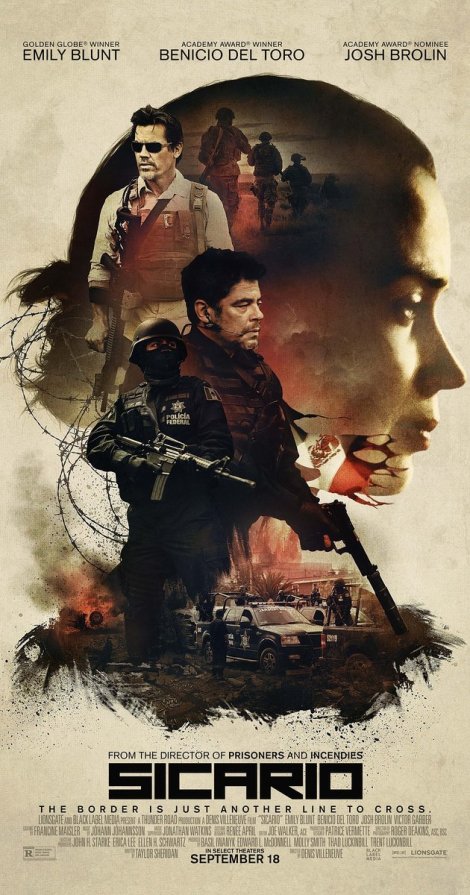
MV5BMjA5NjM3NTk1M15BMl5BanBnXkFtZTgwMzg1MzU2NjE@._V1_UY1200_CR85,0,630,1200_AL_

Sicario (2015) is distributed by Lionsgate and Black Label Media. Rated R.            Available on Blu-Ray and as a digital download.

Categories: Essay Series | 4 Comments

Bloodlines and Borderlines in Louisiana: Grappling with Cajun Identity in Borderlands History

This entry is the first in a series that Jessica will be writing for the blog about her personal and professional journey developing and researching her dissertation topic as a doctoral candidate in Borderlands history. She welcomes all constructive feedback in the comments section and hopes to spark a broader conversation about identity and regional borders over the coming months. -ed

About midway through my dissertation proposal defense, Dr. Jeff Shepherd, my dissertation chair at the University of Texas at El Paso, asked: “how does your project fit into Borderlands history.”  I was not surprised by the question, but I remained stumped for some reason and gave a canned response. His question lingered after I became ABD. How does your project fit into Borderlands history, or a problem like it, is a question on every graduate student’s mind who studies in this field.

As to why I am struggling with this question may have to do with my topic, Cajun history, in particular, Cajun identity.  Cajun history begins with the early French Acadian settlements on the tidal flats of present-day Nova Scotia.  Imperial competition grew and in 1755, the British expelled the French Acadia settlers and scattered them throughout British North America, Caribbean, South American coast, the Falkland Islands, or France.  After that, many Acadian exiles residing in France traveled to Louisiana and were welcomed under the Spanish crown hoping to increase the territory’s population. Continue reading

Categories: Essay Series, Teaching/Professional Development | 1 Comment

Website Built with WordPress.com.