Uncategorized

Tucson’s Shrine to “El Tiradito”

Brett Hendrickson, a Religious Studies scholar at Lafayette University, wrote the following piece  for the blog  Religion in the American West on the folk saint “El Tiradito” and his shrine in Tucson, Arizona. Hendrickson has studied and written about curanderismo and folk saints in depth. His book, Border Medicine: A Transcultural History of Mexican American Curanderismo,  (link) is coming out at the end of 2014 from New York University Press. I met him at the University of New Mexico’s annual “Traditional Healing Without Borders” class two summers ago, and we have stayed in touch ever since.  Last fall we participated in a panel on Religion and Healing in the Borderlands at the 2013 Western Historical Conference and we continue to share ideas and information about curanderismo in the  U.S.-Mexico borderlands. Brett agreed to let me share this piece, originally posted on the  Religion in the American West  blog he regularly contributes to.

May 30, 2014
Tucson’s Shrine to “El Tiradito”

by Brett Hendrickson

On both sides of the international border with Mexico, devotions to so-called folk saints flourish. Some of the major figures include Jesús Malverde, the Niño Fidencio, and—of late (pun intended)—Santa Muerte. Often unorthodox, these figures once operated on the institutional edges of Catholicism, but nowadays, they often extend their power and care over devotees with multiple religious backgrounds and histories. Unlikely ever to gain official canonization, borderlands folk saints nevertheless remain the focus of a great deal of material religious activity. Continue reading

Categories: Uncategorized | Leave a comment

Bizarre Borders on the Zigg-Zaggy U.S. Canadian Border

Here’s a great video by the CGP Grey people people about some things you may not have known about the creation of the U.S. Canadian border, and how imprecise it is.

Via NPR:‘Don’t Touch Me,’ Said Canada. ‘I Won’t!’ Said The U.S.A. So They Moved 20 Feet Apart

Categories: Uncategorized | 1 Comment

“Educating the Native in His Land:” Exploring Nineteenth and Twentieth–Century Imperialism within the Global American Borderlands, 1850s to 1950s

This analysis will explore colonial interactions within two U.S. foreign involvements through the lens of Borderlands History: the Philippines and Hawaii. Using the lens of interaction as a category of analysis, I will talk about how sexual and racial anxieties experienced by populations outside of North America have been in ongoing tension and unremitting negotiation with the American nation. By intentionally placing the Philippines and Hawaii into the realm of borderlands, scholars can further explore the transnational nature of borders, imperialisms, and societies.

The Philippines

As Julian Go contends, U.S. imperialism in the Philippines was singular for many reasons: the 1898 Treaty of Paris ceded the archipelago to the Americans rather than to Filipinos, and the terms of appropriation involved the “legally codified establishment of direct political domination over a foreign territory and peoples.”[1] Island occupation spoke to the larger phenomenon surrounding the emergence of modern empires, such as the U.S., Japan and the U.K., as well as their shared goal in the acquisition of land. Their distant location and increasing western interests made the islands not only “exceptional,” but also illustrative of efforts to colonize societies located far beyond the continent. Continue reading

Categories: Uncategorized | Tags: , , | Leave a comment

Doing Research in Local Archives

photo 2

I recently took a research trip to South Texas to further investigate the turn-of-the-century curandero (faith healer) Don Pedrito Jaramillo, one of the subjects of my dissertation. The main purpose of this trip was to look at the J.T. Canales Estate Papers at the South Texas Archives at Texas A&M-Kingsville. I told myself that if I had time, I would travel to the place Don Pedrito lived from approximately 1881 until his death in 1907: Falfurrias, a town of about five thousand people, forty miles southeast of Kingsville and 120 miles north of the Brownsville-Matamoros border-crossing. I figured a day would be adequate as I mainly wanted to visit the Don Pedrito Jaramillo Shrine that I had discovered the previous summer on a similar research trip, and experience the place where Don Pedrito spent part of his life healing people. I did not plan to find “factual” historical evidence in Falfurrias useful for my dissertation, yet the day spent in Falfurrias was invaluable to my research in ways I did not foresee. The visit changed the way I think about history and about the stories we tell as historians. Continue reading

Categories: Uncategorized | 10 Comments

Review: Manifesting America: The Imperial Construction of U.S. National Space

Rifkin, Mark. Manifesting America: The Imperial Construction of U.S. National Space. Oxford: Oxford University Press, 2009. 290 pp. Paperback. $26.96.

Image

Mark Rifkin’s Manifesting America is a pathbreaking and discipline-shattering examination of 1810 to 1850s imperial and subaltern rhetoric between U.S. national authorities and marginalized populations such as Amerindians, early Californios, and ethnic Mexicans. Rifkin extrapolates American legal documents such as the 1848 Treaty of Guadalupe-Hidalgo to illustrate how the imperial structure of U.S. jurisdiction over the last two centuries created a “simulation of consent” between marginalized peoples and the state (5). He argues that the ways “internalized populations” appropriated and contested North American geographies in a range of “non-fictional writings” demonstrates how U.S. imperial hegemony became embedded in the very language and society of these peoples (6–7).

Manifesting America is divided into four complementary chapters, each examining the manner in which the government articulated sovereignty and authority over contested lands. The first part deconstructs the rhetoric of the 1830 Indian Removal Act and how the U.S. framed “a certain geopolitical grammar” to justify America’s forced migration of Amerindians, especially Cherokees (49, 57). The second chapter examines the rhetoric of popular American figures like Thomas Jefferson and explains how war and expansion exacerbated the legal “inbetweeness” of Anglos and Amerindians (78). The next section investigates Texan property holdings and draws connections between the political identity and economic privilege of ethnic Mexicans, Comanches and Tejanos. The last chapter inspects Californio land claims with the “reservation-paradigm” that allowed the vehicle of violence to legally place indigenous land in the ownership of Anglos and Californios. Each segment of the book provides the reader with several examples of how American imperial rhetoric placated and abused marginalized peoples, and irrevocably appropriated land into national space. Continue reading

Categories: Uncategorized | Leave a comment

CFP: Bridging North America: Connections and Divides

The official announcement by the journal organizers as originally posted on H-Borderlands is below. -ed

CFP: Bridging North America: Connections and Divides

University of Turku, Finland

August 28-30, 2014

The John Morton Center for North American Studies, established at the University of Turku in 2014, invites proposals for previously unpublished papers for its inaugural conference, “Bridging North America: Connections and Divides,” to be held on August 28-30, 2014. The conference seeks to bring together junior and senior scholars from inter/disciplinary backgrounds from the social sciences and the humanities to explore various cultural, socioeconomic, geographic, and political connections and divides between the United States, Canada, and Mexico, and their global ramifications. The papers may deal with either historical perspectives or contemporary issues, and they may include both empirical and theoretical considerations. We particularly encourage submissions that engage in interdisciplinary and multi-methodological discussions on the study of North America.

Continue reading

Categories: Uncategorized | Tags: | Leave a comment

Book Review: Standing on Common Ground: The Making of a Sunbelt Borderland

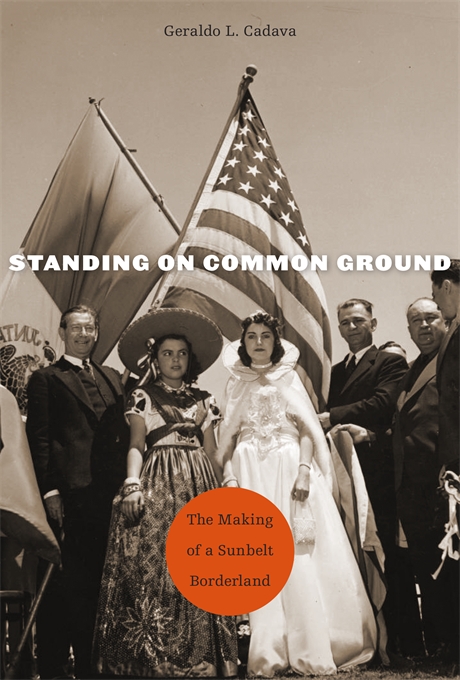
Cadava, Geraldo L. Standing on Common Ground: The Making of a Sunbelt Borderland. Cambridge, MA: Harvard University Press, 2013. 320 pp. Hardcover. $39.95

Standing on Common Ground, Cover

Geraldo L. Cadava’s Standing on Common Ground: the Making of a Sunbelt Borderland is a richly detailed investigation of postwar Tucson and its social, political, economic, and cultural significance to Arizona and Sonora. The author draws on well-crafted case studies of persons and institutions, posing them as emblematic of the region’s larger history and historical relationships. The book is strongest when describing the sociocultural landscape of its host city. Tucson comes alive on the page, and Cadava does an excellent job interweaving multiple narratives into a cohesive story that contextualizes the region’s colonial past within the construction of twentieth-century racial, political, and cultural structures.

Continue reading

Categories: Uncategorized | 2 Comments

Bodies on the Border

The following link will take you to a short documentary about bodies of migrants found in the Arizona desert. It asks the question: “They broke the law, but does that mean they deserve to die?”

There are strong images here, but it is very much worth watching. Continue reading

Categories: Uncategorized | Leave a comment

Call for Book Reviews

Howdy folks,

Tim Bowman here from West Texas A&M University. The following is a “call for book reviews” that I write in my capacity as Book Review Editor for the West Texas Historical Review. Our journal is published annually, so any completed reviews of the following titles will be published in next year’s edition of the journal. Scholars of the U.S. West, Texas, Native Americans and the U.S.-Mexico borderlands should find some of these appealing.

Continue reading

Categories: Uncategorized | 2 Comments

Editorial: Immigration Bills Are Not Reform by Miguel Levario

Borderlands History blog is pleased to host this editorial on the immigration legislation currently being debated in congress, written by historian Miguel Levario, author of Militarizing the Border: When Mexicans Became the Enemy (Texas A&M University Press, 2012). 

As the debate rages on in both the Senate and the House of Representatives regarding immigration policy, we must be clear that the proposals are not about reform. Both the Senate and House versions do NOT improve our immigration infrastructure but rather expand it.  Everything from legalizing the status of millions of undocumented residents to militarizing the border is not a shift or improvement in American policy.

First, let me begin with one of the most glaring problems with the latest Senate version of the immigration bill, which is the collapsing of immigration and border security into one singular entity.  Immigration and border security are inherently contradictory.  Immigration suggests openness and movement while border militarization and security suggests closure and resistance to outside influences.  More specifically, according to the proposal, a path to citizenship for millions of undocumented residents would not be fully realized until the border is 100% secure.   Continue reading

Categories: Uncategorized | Leave a comment

Website Built with WordPress.com.