Author Archives: Michael K. Bess

About Michael K. Bess

Mike is an Assistant Professor of History at the Centro de Investigación y Docencia Económicas, studying road building and mobility in Mexico and the U.S.-Mexico border. His research interests include the history of technology, modernization, and the environment.

Film Notes: Dread and Despair in Desierto

Desierto (2016) is a kind of horror story, and one seemingly tailor-made for this overheated US presidential election. As the Republican candidate has stoked xenophobia and recently delivered an angry speech in Arizona, this film—although imperfectly—illustrates how violence can occur when a whole group of people are denied their humanity.

Written and directed by Jonás Cuarón, Desierto tells the story of undocumented immigrants attempting to cross into the United States. It shines light on a small fragment of a much larger history of immigration in the U.S.-Mexico borderlands. From the Mexican Revolution, which saw thousands cross into the United States to escape violence, to the forced repatriation programs that the U.S. government carried out in the Great Depression, it is a history marked by individual and communal hardship. Looking further into the twentieth century, this sense of Mexican labor  as “cheap,” with workers seen as “disposable” (a subtext to the film) can be traced to the Bracero program (1942-1964), and later to the heavy economic impact of NAFTA on rural Mexican communities in the 1990s.

The film opens on a long, slow panoramic view of the Arizona-Sonora desert. A wood-panel truck carrying the immigrants stops, unable to go further. The coyotes, including one played by Diego Cataño, orders the group out to begin the rest of the trek on foot. The audience follows the story from the perspective of Moises (Gael García Bernal), who was hoping to reunite with him family after having been arrested and deported for a minor traffic violation.

Unknown to this group, a monster lurks in this desert. The audience receives its first glimpses of the villain, Sam (Jeffrey Dean Morgan), driving in a pick-up truck, listening to country music. Attached to the back bumper of the vehicle is a dusty, yellow “don’t’ tread on me” sticker. Along with his trusty dog Tracker, Sam patrols the sparse landscape, while downing hefty amounts of whisky. At one moment, he stops to chat with a Border patrol officer. After traveling deeper into the remote landscape, he comes across the small group of immigrants exhausted under the hot sun. From a distance, he takes position and with a rifle, takes aim.

It is at this moment the viewer realizes that Desierto is something very different from the quite, brooding film that opened. With a sparse script that has the actors showing their emotions on-screen more than talking through the scenes, what follows is a brutal and violent narrative. Like any horror film, the monster decimates the group with a series of swift blows, and then slowly and methodically hunts down the desperate survivors. It is bloody business, made harder to watch given the cruelty of the act. Morgan, with only a handful of words spoken during the entire film, dominates the screen and leaves one with a deep sense of dread as he prowls further into this ugly massacre.

Countering Morgan’s villainy, García Bernal delivers a strong performance. It acknowledges the desperate ordeal his character is in, while also finding a deeper strength as he tries to escape with another immigrant, Adela (Alondra Hidalgo). What ensues is a taut cat-and-mouse game across the rocky, arid landscape. The desert cinematography is captivating, and plays its own part in setting the feel of the film’s atmosphere for the audience. It is a beautiful background for what is otherwise an unrelentingly dark and violent story.

Ultimately, Desierto remains uncomfortable and deeply disturbing throughout much of its 90-minute length. Given the fraught politics of race and identity, as well as the everyday violence witnessed in communities in the United States and Mexico, the film’s exaggerated premise still felt a little too real. With its loose script, the director also leaves much of the interpretation up to the audience. We know that what Morgan’s Sam is doing is wrong, and we know that García Bernal’s Moises is the hero, but many of the scenes haunted me long after I’d left the theater. Perhaps, that was Cuarón’s intent.

Desierto-French-Poster

Desierto premiered in France and Mexico in April 2016. It will be out in US theaters in October.

Lina Murillo helped with the editing of this review. 

Categories: Films | Leave a comment

CFP: Native American and Indigenous Studies Association Annual Meeting

The Native American and Indigenous Studies Association has launched a call for paper for it’s ninth annual meeting, which will occur in Vancouver, British Columbia, from June 22-24, 2017. The organizers are accepting proposals for individual papers, panels, roundtables, and film screenings. Submissions of a broad range of diverse and interdisciplinary scholarly topics are encouraged.  More from the announcement:

All persons working in Native American and Indigenous Studies are invited and encouraged to apply. Proposals are welcome from faculty and students in colleges, universities, and tribal colleges; from community-based scholars and elders; and from professionals working in the field. We especially encourage proposals relating to Indigenous community-driven scholarship.

Visit NAISA’s conference website for additional information, including how to apply.

Categories: Calls for Papers, conferences, News and Announcements | Leave a comment

CFP: UTEP Borderlands History conference

The deadline for submissions to the second UTEP Borderlands History conference is approaching: September 23. The organizers invite scholars to send in proposals for individual papers and panels of 3-4 participants on a wide range of topics related to the study of borderlands. From the conference description:

This year’s theme, Shifting Borders: Gender, Family, and Community, encourages scholars of the U.S.-Mexico borderlands to explore the myriad ways social norms have been constructed, have changed over time, and have been  influenced by the unique opportunities, obstacles, and paradoxes of la frontera. This inquiry into the lives of borderlanders, though not new, is today flourishing in novel ways. Since at least the late 1970s, borderlands scholars have blended social historical approaches with borderlands history to describe the lived experiences of borderlands people. More recently, the field has shifted toward the construction of identity in the borderlands, drawing on new approaches to race and gender and paving the way for new lines of research, including new interest in communities and families. Since then, scholars have applied the tools of women’s studies and cultural history to borderlands history.

For more information, follow the link.

Categories: Calls for Papers, News and Announcements | Leave a comment

Pedagogy Notes: On Thinking about Borderlands in World History

This is the second installment in our pedagogy series. We invite you to join the discussion in our comments section at the bottom of the post.

At CIDE Región Centro, in 2014, when I started teaching my World history I course, I wanted to incorporate a Borderlands history perspective into my lectures and class discussions. Imperial frontiers is a topic that I have long found fascinating, and now given the chance, I wanted to explore it further with students. One of my favorite readings on this subject, which I assigned to students for group discussion, was Porfirio Sanz Camañes’s “Frontera, límites y espacios de confrontación en la América Hispana durante el siglo XVIII.” In it, Sanz examines the conflicts that occurred in the region of Río de la Plata before a new treaty was signed between Spain and Portugal. Sanz considers how the concept of the “frontier” and “border” evolved during the colonial period. It’s a great essay that also helped me conceive my lectures on the colonial empires in South America.

Another reading that has been very useful in conceptualizing borders and frontiers in my World history class is Nelson Eduardo Rodríguez’s “El imperio contraataca: las expediciones militares de Antonio Caballero y Góngora al Darién, 1784-1790.” Rodríguez contextualizes the Darien region of Panama as a colonial frontier where indigenous people and smugglers resisted and bedeviled settler officials who tried to subject the region to the crown’s authority. Throughout the eighteenth century, this porous “borderland” pertained and became a site Great Britain exploited to pressure the geopolitical power of their Spanish rivals in the western Caribbean.

Many of the students who I teach grew up in central Mexico and the region of the Bajío, which includes the state of Aguascalientes, where I live and work. When I’m developing my classes on New Spain, David Weber’s work, especially Bárbaros: Spaniards and Their Savages in the Age of Enlightenment, remains an important resource for writing and revising lectures. The discussion of frontiers that Weber uses really helps me to add an appreciation of “empire” as a process constructed through cultural and economic change as well as the application of violence to subject indigenous people to colonial power. In this context, I emphasize to the class the critical role that the Bajío played in facilitating the deployment of Spanish power to northern New Spain.

Likewise, Peter Sahlins’s excellent, Boundaries: The Making of France and Spain in the Pyrenees, has been very useful when I’m covering the development of nation-states. I urge students to identify the historical context of creating borders and the often bloody impact of this work. One of my favorite moments during the semester is when students really grasp the constructed and artificial character of the nation-states that we consider to be almost “timeless” monolithic entities.

Ultimately, I want to use the themes of borders and frontiers in World history to help students conceptualize the political relationships that marked the early modern world and gradually influenced the evolution of nation-states. I see it as an opportunity to connect present-day debates around borders and migration to the historical context of these issues in the colonial period. In this sense, a Borderlands history perspective has helped me to make connections across different regions and time periods in the lectures and discussions we have in the course.

Categories: Teaching/Professional Development | 2 Comments

Conference Notes: LASA 2016

At the end of the spring semester, I had the opportunity to attend and present my work at this year’s Conference of the Latin American Studies Association in New York City. The meeting brought thousands of specialists of Latin America to the Big Apple’s Midtown Hilton and Sheraton Times Square hotels. I landed in JFK on Thursday late afternoon and took an Uber into the city. Checking into my hotel in the West Village that evening, I made it to the conference site at the start of the next day. Already the Hilton lobby was packed with attendees for a full schedule of panels and other events over Memorial Day Weekend. In total, more than six thousand people participated in this year’s LASA with over 1,400 panels listed in the program. The conference’s film festival also screened dozens of works.

Bustling Times Square, photo by author.

For historians of the U.S.-Mexico Borderlands, there were a handful of interesting bilingual panels presenting papers on mobility, immigration policy, cultural and social analysis, drug policy, and historical memory of the region. On Friday morning, Amelia A. Hall of the University of Alberta was scheduled to give her paper, “The Badasses of Bad Movies: Border Hybridity, Women’s Models, and Gendered National Identity in Cine Fronterizo.” Unfortunately, it was difficult make it to everything given that a lot of related panels were occurring at the same time. Down the hall, Marta M. Caminero-Santangelo, of the University of Kansas, had organized a panel on literary depictions of border crossings, which looked at the DREAMers, as well as the Caribbean context of the border (Marisel C Moreno, University of Notre Dame), and Latinx literary aesthetics (Ylce Irizarry).

Of course, being New York City in springtime, there were countless things to do outside the hotel’s walls. Walking through midtown Manhattan, people wearing their attendee badges could be seen enjoying all that the area had to offer. Although the heat was sweltering, I joined friends for walks in Central Park, strolled Fifth Avenue, and later had dinner nearby the conference at the tasty and affordable, Topaz Thai.

The next day, I was excited to attend an early evening panel organized by Stanford University’s Mateo J. Carillo, and chaired by Julia G. Young of the Catholic University of America, on transnational migrant mobilities. Being an historian of transport mobility in northern Mexico, myself, this session was right up my alley (pun intended). The first presenter, Laura D. Gutierrez from the University of California-San Diego, spoke on the history of the Bracero program and punitive deportations. One aspect of the work that really captivated my interest was Gutierrez’s analysis of the power and limits of the U.S. and Mexican bureaucracies that exerted power over transnational workers. Following Gutierrez, Carillo spoke about the history of road building in the Bajío, a northwest-central region of Mexico, and its impact on the mobilization of agricultural workers who traveled for jobs in the United States. Carillo rightly emphasized that new roads played a crucial role in this labor history from the 1940s to the 1960s. Lastly, Yuridia Ramirez of Duke University, presented her work on the links that form between Mexican migrant communities in North Carolina and their families and friends remaining in the Bajío. She analyzed themes of identity production and cultural heritage, and the role that education played. The discussion that followed was lively. Afterwards, I joined colleagues for dinner at the aptly named House of Brews.

My panel, organized by my friend and colleague Catherine Vézina of the Centro de Investigación y Docencia Económicas (CIDE), was scheduled for Monday morning in the Times Square Sheraton. It began with José Alberto Moreno Chávez of El Colegio de México (Colmex) who spoke about cosmopolitan culture and modernization in Mexico City through a fascinating analysis of how elites wrote and thought about popular terms, including “Snob” and “Fresa,” which invariably included historical context of U.S. cultural influence. I followed with a presentation on rural road-building campaigns in Mexico, including the northern Mexican state of Nuevo León, where transportation companies pressed the government for more highways in support of domestic and U.S. tourism along the border. Catherine continued, giving a paper on the implications of the bracero program to bilateral policy initiatives and questioning the impact on modernization schemes in Mexico. After her, Valeria Sánchez Michel, also of CIDE, discussed the history of modernization related to Mexican higher education in the 1950s, exploring the cultural representations that planners hoped to impose as well as how this ideal contrasted with students’ everyday life and demand for reforms. Finally, Colmex’s Vanni Pettina concluded the panel with a lively discussion of his work on bilateral relations between the Soviet Union and Mexico during the late 1950s and early 1960s as Mexican President Adolfo Lopéz Mateos navigated the diplomatic currents of the Cold War.

Following the panel, it was time to grab a coffee, check into some other sessions, meet more friends and colleagues, and later explore more of the city. The weekend was packed and like any LASA conference, it’s hard to make it to every panel and event that piques your interest. Nevertheless, it was a great experience that brought together a wide gathering of the academic community on Latin America in a diverse, multicultural and multidisciplinary atmosphere. If you were at LASA this year, share your experiences about the panels (especially borderlands-themed sessions) in the comments below!

Categories: conferences, Events | Leave a comment

CFP: Policing the North American Borderlands

Dear readers, below we’re reposting a call for papers for what we believe will become an important new contribution to Borderlands historiography. 

CALL FOR PAPERS
POLICING THE NORTH AMERICAN BORDERLANDS

We solicit proposals for an edited volume entitled Policing the North American Borderlands. This volume will trace the development of state regulation and policing practices along the US-Canada and US-Mexico borders, as well as their impacts on border people during the nineteenth and twentieth centuries.  Although war and diplomacy established borders on paper, policing made boundaries into borders and in some cases barriers.  We seek papers that examine how policies and state apparatuses create and regulate national borders and how this impacts communities which cross international divides.  We ask for papers that explore how particular legal codes and regulatory practices have attempted to define and delineate the parameters of the state; how citizenship is defined in both law and in practice; and how state regulatory apparatuses monitor and police flows of goods and people across international divides.  This book is centered on two key questions: how has the state (at the federal, state, provincial, and local levels) attempted to regulate and police people and goods at their actual borders; and how have local communities responded to, been shaped by, and/or undermined particular policing objectives and practices?

Too often, studies and discussions of the US-Canada and US-Mexico borders happen in isolation from one another.  Policing the North American Borderlands will therefore place analyses of policing practices along the northern and southern borders into direct conversation with one another.  We are especially interested in papers that take a comparative and connective approach.  How have states implemented policies and practices along the contested terrain that makes up each border region?  How do concepts of race, ethnicity, gender, and power shape interactions along these borders?  By examining the history of policing North America’s borderlands comparatively, we hope not only to trace the development of very different national borders but also shed light on contemporary border security concerns.  Continue reading

Categories: Calls for Papers | Leave a comment

Race and Identity in Borderlands Food Culture

Dear readers, the New Yorker has just published a fascinating essay about the Afghanistan immigrant, Zarif Khan, who arrived in Wyoming at the turn of the twentieth century. His life crossed national and cultural boundaries as he made his home in North America. Khan went one to become famous for selling tamales across the region and not only gained the nickname “Hot Tamale Louie,” but also U.S. citizenship (twice). The feature, by Kathryn Schulz, explores historical issues tied to race and ethnic identity, and also how these characteristics are interpreted by local and foreign groups. Likewise, the impact of food culture and how it is viewed by communities is an important part of this story.

For more on Khan’s life, read the full article, here.

Categories: News and Announcements | 2 Comments

Seminar Notes: Developing Transboundary Institutions

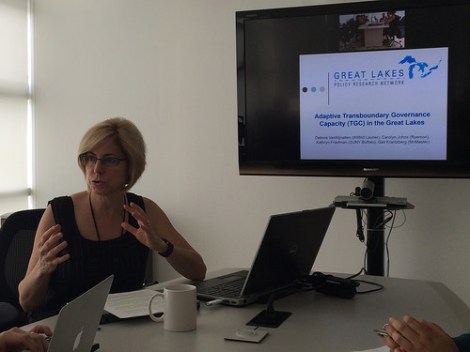
Last month, the Centro de Investigación y Docencia Económicas, where I work, hosted Dr. Debora VanNijnatten, an Associate Professor and Chair of the Political Science and North American Studies department at Wilfrid Laurier University. She specializes in issues of bilateral governance across North America, and is working with a research group examining how institutions coordinate across borders to tackle environmental challenges, including climate change. Although she has also studied the U.S.-Mexico border, currently her work is focused on the Great Lakes region to understand how the United States and Canada handle shipping, resource management, and other activities. It is a region with a long history of treaties and binational agreements, which has forged a highly institutionalized space to address concerns of land and water use.

26759069292_c92dc66128

Dr. Debora VanNijnatten. Photo credit: Dr. Raul Pacheco-Vega.

During the seminar, Dr. VanNijnatten noted that although there are a number of binational institutions in place, significant environmental problems that are difficult to resolve continue to face the region. Organizations have successfully addressed targeted problems, but larger, and more complex issues, such as dealing with cross-sector challenges that affect numerous communities and public/private interests, are a much harder task. Many scientists who study the Great Lakes area are concerned that this border region is at an ecological tipping point.

As a historian of the US-Mexico borderlands, what struck me most about Dr. VanNijnatten’s work is the importance of thinking about the history of institutions and transboundary governance. Certainly, issues of water and land use have deeply marked the U.S.-Mexico border region as well; from the impact of building of the Hoover Dam for the Colorado River Basin to modern-day disputes over water management in times of severe drought. A multidisciplinary approach that incorporates an understanding of policymaking and quantitative/qualitative methods, within an historical context, can be useful to chart the longue durée of local, state, and federal decision-making in everyday life along the border. The industrial and transport infrastructure built between nations affects economic access for regional communities (benefitting some places more than others) and also leaves a lasting mark on the natural environment. An historical understanding of the institutions that were formed to determine and enforce bilateral agreements is critical to developing a clearer view of how people cope with the challenges of managing borderlands resources.

Returning to Dr. VanNijnatten’s work, her group is developing a model to understand transboundary governance. They’re looking at a wide range of topics that affect communities and institutions, including degrees of compliance, info-sharing, and legal and political legitimacy. She notes that an important aspect of transboundary governance is how networks (people and communities) interact with institutions (government agencies, etc.) to understand and respond to regional problems. Her team finds that even in borderland areas, like the Great Lakes, with a long history of bilateral agreements, there still occurs considerable amounts of fragmentation and lack of coordination between nation-states. Thinking about how these themes address the history of the U.S.-Mexico border can inform our own work on the institutionalization of political and economic priorities in this region.

For more of Dr. VanNijnatten’s work, click here. My colleague, Dr. Raul Pacheco-Vega, has also written about this seminar, here.

Categories: conferences | Leave a comment

Summer Book Sale at OU Press

Dear readers, like any academic, we love a good book sale, too. The University of Oklahoma Press has just announced its summer sale with a large selection of titles available for up to 40%. For more details, follow the link.

2016-Summer-Sale--700px-wide

Categories: Book Sale, News and Announcements | Leave a comment

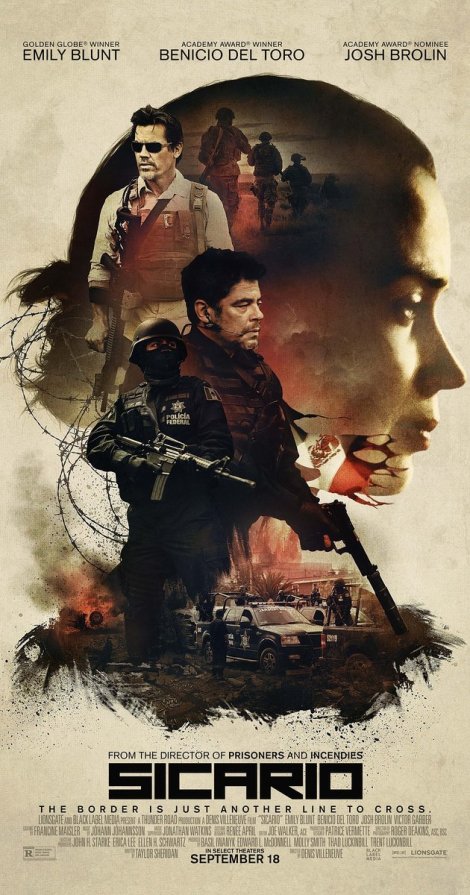
Film Notes: The Problematic Beauty of Sicario

I had intended to see Sicario (2015) when it arrived in theaters. Classes, grading, paper revisions, and committee meetings got in the way, and by the time the semester had ended it was gone from cinemas. Recently, the film appeared on Netflix in Mexico, where I live. Sicario is visually striking. The camera pans across mountains that shape the landscape around El Paso and Juárez as a brooding score adds a sense of dread. Viewers familiar with the areas depicted in the film will notice many landmarks; UTEP along I-10 peeks out in the distance; there’s a beautiful view of the Parque Público Federal El Chamizal; the Santa Fe and Córdoba bridges feature prominently as set pieces, early on in the narrative.

Some have likened Sicario to an earlier drug war movie, Traffic (2000). The parallel is not entirely correct. Although this film sees Benicio del Toro reprise the role of a disillusioned Mexican law enforcement officer willing to blur the lines of what is right and wrong, the similarities end there. At other times, Sicario felt like a spiritual sequel to Zero Dark Thirty (2012). The cinematography is stylistic, plodding, and punctuated by bursts of intense violence. Actors depicting members of Delta Force figure prominently as they join a nihilistic and shadowy operator played by Josh Brolin, who carries out a mission in Juárez escorted by Mexican Federal Police. Like Zero Dark Thirty, it also justifies torturing informants. The narrative vehicle for the audience is embodied by Emily Blunt who plays a FBI hostage rescue specialist, channelling a sense of confusion and frustration at the events she sees once she agrees to join Brolin’s team in the aftermath of a difficult police raid in Arizona.

Once Sicario is in the thick of its narrative, it transforms into a kind of macabre Alice in Wonderland. The audience is brought down into the tunnels that cross beneath the U.S.-Mexican border. The camera switches to disorienting night-vision and thermal-vision tones of green, grey, black, and white. It is a looking glass onto a violent, otherworldly landscape. And there’s this growing sense of realization that, perhaps, Blunt’s character isn’t the focus of the film after all, and it has another story to tell us.

From an historical perspective, there is a deeper problem with this film. It is an ahistorical mash. A comic book story about cartels and killers that mixes time periods and provides little context to the viewer of the origins and reasons for the drug war. Soon after the film’s start, U.S. agencies, perhaps channeling General John J. Pershing, launch a coordinated punitive raid with Mexican federal counterparts against the Sonora cartel in response to an IED-style attack near Phoenix. Where did these guerrilla tactics come from? Where, and how, did the cartels accrue such power? Sicario is deafeningly silent about the American role in the drug war. Brolin’s character longs for the status quo ante of the 1980s, but this nightmare-cum-dream, too, is a red herring meant to confuse audiences. The film’s narrative is an ouroboros of violence and revenge.

Ultimately, the feeling coming out of Sicario is empty. Yes, it is expertly filmed and acted. Along the way, audiences are treated to solid performances, including by supporting actors, Daniel Kaluuya, Maximiliano Hernández, Jeffrey Donovan, and Jon Bernthal. Director Denis Villeneuve and cinematographer Roger Deakins capture the beauty and desolation of the natural landscape that stands in sharp contrast to the bustling cities and towns along the border.

The craftsmanship, however, does not negate the sense that the journey audiences follow through these arid scenes may simply lead to a dead end. The film does little to challenge stereotypes about this region; in fact, it steeps itself in violence, not as means to educate viewers, but rather to set the scene for the next bloody action sequence. Given the politics of perception around the U.S.-Mexico border, Sicario is counterproductive. The film does not adequately address the question it implicitly poses to the audience: how, if ever, can a resolution be reached to the social problems that affect the border when only violence begets violence?

MV5BMjA5NjM3NTk1M15BMl5BanBnXkFtZTgwMzg1MzU2NjE@._V1_UY1200_CR85,0,630,1200_AL_

Sicario (2015) is distributed by Lionsgate and Black Label Media. Rated R.            Available on Blu-Ray and as a digital download.

Categories: Essay Series | 4 Comments

Website Built with WordPress.com.