Author Archives: Michael K. Bess

About Michael K. Bess

Mike is an Assistant Professor of History at the Centro de Investigación y Docencia Económicas, studying road building and mobility in Mexico and the U.S.-Mexico border. His research interests include the history of technology, modernization, and the environment.

CFP: SMU Dissertation Writing Workshop

Dear readers, we wanted you to know about a great upcoming opportunity for graduate students. The Clements Center at Southern Methodist University has launched a call for papers for its 11th annual Western History Dissertation Workshop. It will be held on Saturday, May 28, 2016, at the university’s satellite campus in Taos, New Mexico in conjunction with a number of partners, including the Lamar Center for the Study of Frontiers and Borders at Yale University and the Center for the Southwest at the University of New Mexico, among others.

image

Graduate students who are at an advanced stage in writing their dissertations are encouraged to apply. Topics can include any aspect of the history or culture of the American West. The workshop organizers will fly five students to Taos, expenses paid, to participate and receive feedback from the group as well as senior scholars. Continue reading

Categories: Teaching/Professional Development | Leave a comment

Border Studies Summer Program in Japan: Call for Applications

Dear readers, Hokkaido University in Japan is accepting applications for participants in its border studies summer program. The university’s Graduate School of Public Policy and the Slavic Eurasian Center will host the summer school in Saporro from 25-28 July, and it is open to studies from all over the world. Sessions will cover thematic and geographic topics, from studies of borders in Europe and Asia to gender and diversity and representations of borderlands in art.

The deadline to apply is 28 February. For more information, follow the link:

Border Studies Summer School, Hokkaido University:
http://src-h.slav.hokudai.ac.jp/ubrj/eng/whats-new/archives/201602/05221.html

Categories: News and Announcements | Leave a comment

Public Lecture: Bill Beezley at NMSU

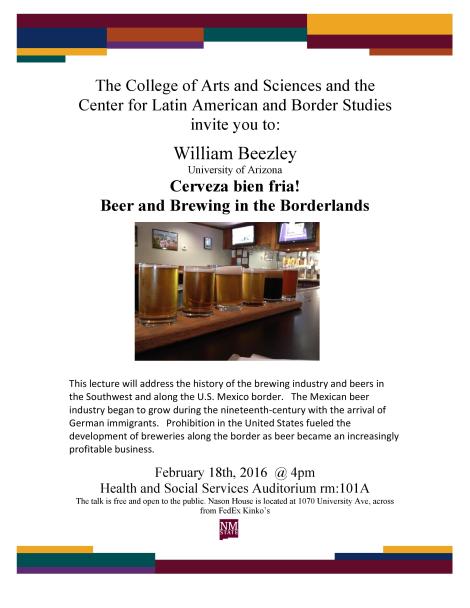
On February 18th, Bill Beezley will be giving a public lecture at New Mexico State University, sponsored by the Center for Latin American and Border Studies. He’ll be speaking on the history of the beer industry in the Mexico-US borderlands. If you’re going to be in the area, check it out! We’ve attached the event flyer.

Bill Beezley, Feb 18th-page-001

Categories: Events | Leave a comment

CFP: 2016 Visual history conference in Mexico City

The Department of Social Sciences and Humanities at Mexico City’s Universidad Autónoma Metropolitana Unidad Iztapalapa has an open calls for submissions for an upcoming conference. The theme for the gathering is “the image as a source for History.” The conference looks to develop interdisciplinary approaches to the study of visual history. The deadline to submit proposals is March 4 and the conference is scheduled to occur from May 16-18.

For more information, we’ve attached the event flyer:

image

Categories: Calls for Papers | Leave a comment

CFP: Citizenship and migration conference, deadline extended

Dear readers, happy new year! We wanted to let you know that the call for papers deadline has been extended for an upcoming conference on citizenship and territory between Asia and North America during the nineteenth century. The deadline is now January 31, and the conference, titled “Traffic, Territory, Citizenship: Framing the Circulation of People and Goods between Asia and the Americas in the Long 19th Century” will be held at Binghamton University from April 15-16. From the notice:

The symposium will feature two keynote sessions, led by guest senior scholars Madhavi Kale (Bryn Mawr College), a historian of Indian indentured labor migration and Indian domesticity, and Robert Hellyer (Wake Forest University), a historian of international trade in Japan and the global tea trade.

Open to any discipline, the symposium will combine sessions organized around questions drawn from participants’ research with presentations on primary sources. In addition to discussion and feedback on their research, participants will also collectively produce a digitally-annotated bibliography of relevant scholarship and a digital archive of primary sources – both to be published online as an integrated exhibit to spur future research and support teaching on the workshop’s themes.

For more information, follow the link:
https://networks.h-net.org/node/23910/discussions/104945/cfp-deadline-extended-131-traffic-territory-citizenship-framing

Categories: conferences | Leave a comment

Thank you, readers!

We wanted to thank all of you who read the blog for your support. We’ve just passed 1,000 followers on Twitter and are excited about growing even more in the coming year. We look forward to continuing this work and having you along for the journey.

Categories: Uncategorized | Leave a comment

Upcoming Event on the Legacy of the Revolution in Northern Mexico

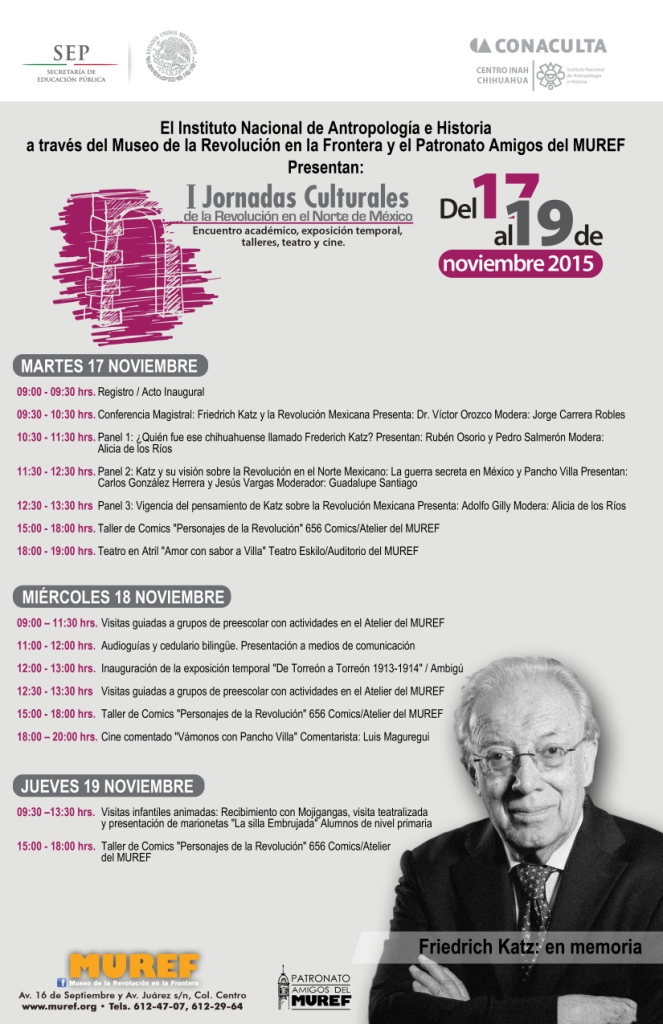
Dear readers, if you’re going to be in Mexico City between November 17th and 19th, we wanted you to know about a great series of panels that will be hosted by the National Institute of Anthropology and History (INAH). The venue for the conference is the Museo de la Revolution en la Frontera. Panels include a retrospective on Friedrich Katz’s work and his perspective on the Revolution in northern Mexico. The event also has workshops and other exhibits scheduled. We’ve included the poster INAH is circulating. For more information, you can also check out the museum’s website: http://www.muref.org

COMPRIMIDO POSTER JORNADAS

Categories: Uncategorized | Leave a comment

Sunday Reading Suggestions: “The Refugees at Our Door” and “Erasing the U.S.-Mexico Border”

Last month, the New York Times ran an excellent profile about how the United States has outsourced to Mexico a crackdown against migrants looking to reach the U.S.-Mexico border. The author, Sonia Nazario, travels to Mexico to meet and write about the people affected by this policy, many of whom are living in shelters across the country. She describes the exhaustive ordeals migrants have endured, walking great distances through difficult mountain terrain, and fearing for their lives against abuse from gangs, the police, and others. The profile includes compelling photography of people’s living conditions. Nazario writes:

Although President Enrique Peña Nieto of Mexico said when he announced the so-called Southern Border Plan that it was to “protect the human rights of migrants as they pass through Mexico,” the opposite has happened. By the Mexican government’s own accounting, 72,000 migrants have been rescued from kidnappers in recent years. They are often tortured and held for ransom. The survivors tell of being enslaved working in marijuana fields or forced into prostitution. Many are killed — sometimes they have organs harvested — in what’s become an invisible, silent slaughter. The government push has been interpreted as open season on migrants who have become prey to an exploding number of criminals and the police who rob, rape, beat and kill them.

In another story we wanted to bring to your attention about a new exhibit along the border that combines art and activism. Writing for the Phoenix New Times, Lynn Trimble describes how artist Ana Teresa Fernández and volunteers have begun painting portions of the border fence that separates Nogales, Sonora from Nogales, Arizona. They “erase” the fence by painting it sky blue, allowing it to blend in with the horizon. It is part of a broader campaign that has seen people do the same elsewhere along the border. Trimble writes:

Fernandez conceived both “paint outs” as a way of erasing the border. By painting the border fence blue to match the sky, she created the illusion that the fence no longer existed along a portion of the border. In each case, she worked alongside others to make it happen. About three dozen people painted with her in Nogales, including ASU students, community members, and her mom — whom Fernandez credits with raising her consciousness of the border.

For the full stories, follow the links. Enjoy!

The Refugees at Our Door

Artist Ana Teresa Fernández on Erasing the U.S.-Mexico Border with Blue Paint

http://www.phoenixnewtimes.com/arts/artist-ana-teresa-fernandez-on-erasing-the-us-mexico-border-with-blue-paint-7761675

Categories: Uncategorized | Leave a comment

CFP: Deadline Extended for 15th Border Regions in Transition Conference.

Good day readers, the organizers of the 15th Border Regions in Transition (BRIT) Conference have extended the deadline for paper and panel proposals to November 15th. The theme of the conference is Cities, States and Borders: From the Local to the Global. It will be hosted between Hamburg, Germany and Sønderborg, Denmark from 17 to 20 May 2016.

Here’s a brief description of the conference themes:

BRIT 2016 is open to contributions from all over the world, and not exclusively to those dedicated to Western European or North American borders which historically have been strongly represented in border studies. Particular attention will be paid to the conceptual and empirical contributions that explore, from the global to the local, the globalized cross-border metropolis and its flows, the reunited city and its scars, the divided city and its walls, the securitized city and its border controls, the small city and its relative indifference to borders, or the border markets and its overflowing activity.

For more info, follow the link:
http://www.sdu.dk/en/Om_SDU/Institutter_centre/I_Graenseforskning/Events/BRIT+2016

Categories: Calls for Papers | Leave a comment

UTEP 2015 Borderlands History Conference

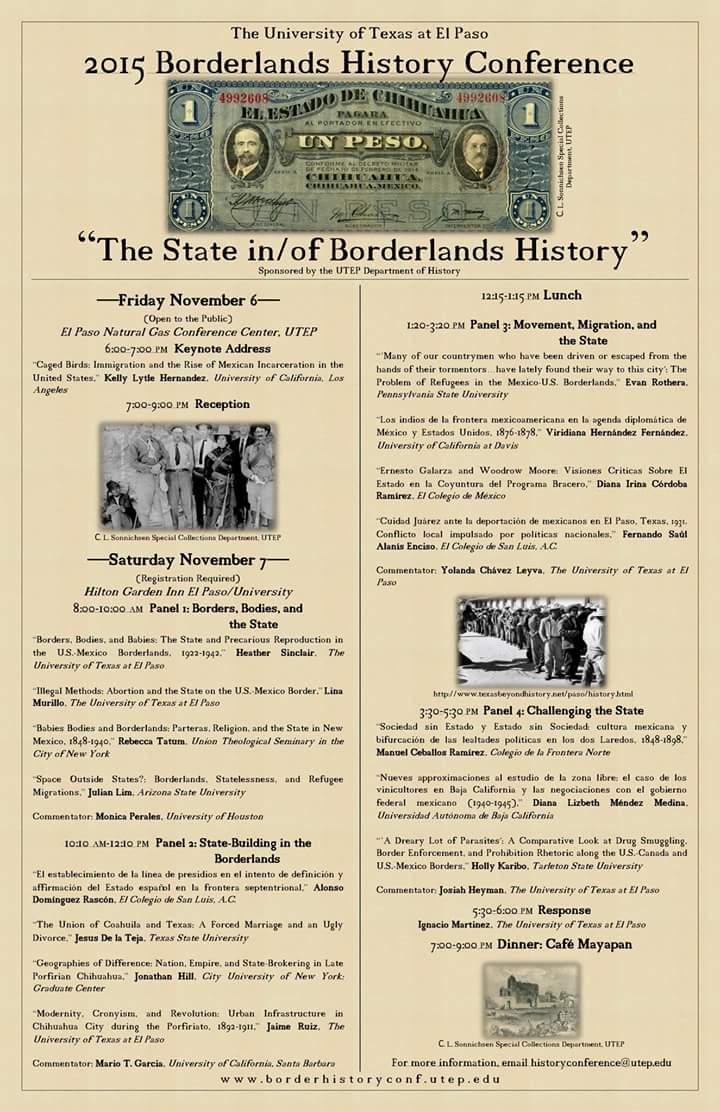
Dear readers, we wanted to share the schedule for UTEP upcoming conference on Borderlands  history. Check it out below (nice work on the design, we might add):

image

Categories: conferences | Leave a comment

Website Built with WordPress.com.