From Dissertation to Book: Writing a Book Proposal

Dear readers, I’d like to introduce Dr. Lori Flores, Assistant Professor of History at SUNY Stony Brook. She has collaborated with us in the past, particularly on a great book review series from last year featuring the work of her graduate students. Now, we have the pleasure of publishing her first post for BHb, which provides some great ideas about adapting one’s work for a book proposal. Most recently, Lori authored Grounds for Dreaming: Mexican Americans, Mexican Immigrants, and the California Farmworker Movement, part of the Lamar Series in Western History published by Yale in 2016. -Mike

I am often asked for advice on how to navigate the transition from completing a dissertation to revising the dissertation into a book, and writing academic book proposals for publishers. Here are seven tips that might help demystify the book proposal process (disclaimer: I’m a historian, but hopefully these tips translate across disciplinary boundaries):

  • See your work with new, fresh eyes.

If you’ve just finished your dissertation, congratulations! Now set it aside for a good while. Trying to tackle dissertation-to-book revisions too soon will prevent you from seeing your graduate school-inspired language, and from knowing what needs to be tweaked, cut, or added in terms of content. Many times, you need a more distant perspective on your work in order to articulate to editors how you plan to produce a book, which is an entirely different beast in terms of framing, style, and structure. Feel free to circulate your work to valued colleagues for their input while you’re gaining that distance, and tackle other passion projects or interesting new readings in your field for some inspiration.

Continue reading

Categories: Teaching/Professional Development | 3 Comments

CFP: American Association for State and Local History (AASLH) Annual Meeting in Austin, TX, September 6-9, 2017

Annual Meeting 2017 Theme: I AM History

The American Association for State and Local History (AASLH) will present its 2017 Annual Meeting in Austin, TX from September 6-9.

I’m part of the conference committee and will be part of the group reviewing proposals. Feel free to get in touch with me if you need presentation and/or panel ideas: http://about.aaslh.org/am-call-for-proposals/

i-am-historyProposals are submitted online and are due December 9. Contact Bethany Hawkins with any questions at hawkins@aaslh.org or 615-320-3203.

Categories: News and Announcements | Leave a comment

Honoring the Legacy of Dr. Mario T. Garcia, October 26, 2016

The UTEP Department of History hosted “Honoring the Legacy of Dr. Mario T. Garcia: A Graduate Student Roundtable Discussion of Chicana/o Movement History,” as part of the University’s 2016 Distinguished Alumni, on Wednesday, October 26, 2016, at the Rubin Center Auditorium on the University campus.

According to the UTEP History Department, Dr. Mario T. Garcia received his BA and MA from the Department of History at UTEP in 1966 and 1968 respectively. He then went on to complete his Ph.D. at the University of California at San Diego.  He is the author of several influential books, including Desert Immigrants: The Mexicans of El Paso, 1880-1920, which focuses on the history of El Paso between 1880 and 1920; as well as The Chicano Movement: Perspectives from the Twenty-First Century; The Latino Generation: Voices of the New America; and Blowout! Sal Castro and the Chicano Struggle for Educational Justice. He has published approximately twenty titles in all.  Dr. Garcia has received numerous awards, including a Guggenheim Fellowship. He is currently a distinguished professor of History and Chicano studies at the University of California, Santa Barbara, where he has been a faculty member for 41 years. The roundtable included student discussions of their research in Chicana/o history, followed by comments from Dr. Mario T. Garcia about his life’s work.  In his presentation, Dr. Garcia spoke about his development as a historian and his challenges and opportunities in writing Chicana/o history.

Dr. Jeffrey Shepherd, Associate Professor and Director of Graduate Studies, opened the session and Dr. Ernesto Chavez, Associate Professor (far right) introduced Dr. Garcia.  Student panelists included (from right to left): Dennis Aguirre, Doctoral Candidate; Melanie Rodriguez, Doctoral Candidate; Angelina Martinez, Doctoral student; Blanca Garcia, Doctoral student; and David Robles, Doctoral Candidate.

Continue reading

Categories: Events, News and Announcements | Leave a comment

Notes on the 2016 UHA Annual Meeting at Chicago

Greetings from Chicago, Illinois!  From the 13 to the 16 of October, 2016, urban historians, city planners, biographers, architects, and public policy specialists convened at the Philip Corboy Law Center of Loyola University Chicago for the Urban History Association’s Eighth Biennial Conference.  David-James (DJ) Gonzales and I had the opportunity to attend and present at this year’s meeting.

We arrived on Friday, October 14 and were able to visit some amazing panels that interrogated the themes of carcerality and the state, urban history before the “city,” settler colonialism, and the lack of scholarship on urban Latinx history.  It is exciting to see over the years how each urban history conference features more and more panels on Latinx neighborhoods, community activism, and radical political thought.  Some of the panels that were scheduled for the weekend included: “The Fight for Immigrant Rights in Los Angeles, Post-1965,” “Latino Studies and the New Urban History,” “Urban Latinos: Ethnic Mexicans, Puerto Ricans, Transnational Communities, and Cities in the Postwar United States,” “Latinos and the Changing World of Urban Work,” and “Rethinking the Boston ‘Bussing Crisis’”

Moreover, there were some great sessions on the connections between ethnicity, immigration, and urban space, as with a plenary on “A City of Immigrants: Immigration Reform since 1965 and its Urban Consequences.”  The panel sought to present post-1965 as a defining point not just for civil rights, but for new groups of Latinx immigrants to the country.  There was also a roundtable titled, “Settler Colonialism in American History?”  This panel was absolutely terrific, especially because of the open conversations the panelists had with the audience.  An individual from the audience posed the question, “Can only native scholars utilize settler colonialism in their research and can settler colonialism only be used to understand native pasts?”  Nathan Connolly, a Black historian of property rights and land in Florida, responded that the moment we start to put restrictions on who can write certain pasts or operate specific optics is the moment white supremacy succeeds.  Llana Barber, a specialist in immigration and Latinx history, concurred and suggested that settler colonialism helps attenuate the differences between different historically-marginalized ethnic groups.  She compared Puerto Rican and Native American pasts, referring to land sovereignty and citizenship rights through the guise of a friendly state.  The roundtable concluded that settler colonialism can and is helpful in thinking through ethnic histories like the Latinx past. Continue reading

Categories: conferences | Leave a comment

New Borderlands History Article: Heather M. Sinclair, “White Plague, Mexican Menace: Migration, Race,Class and Gendered Contagion in El Paso, Texas, 1880-1930”

Abstract:
This article examines a debate that emerged in El Paso, Texas at the turn of the twentieth century surrounding the transmission of pulmonary tuberculosis from predominantly Anglo American migrants to the city’s ethnic Mexican population. Reports of Anglo-to-Mexican infections came from cities and towns throughout the U.S. Southwest, but by 1915 El Paso had emerged as the epicenter of the debate. Using popular and professional sources, the article tracks a shift in dominant perceptions of tubercular contagion from an association with white bodies to Mexican ones. An early narrative casts the Mexican female domestic servant as a victim of the infectious indigent white consumptive male health seeker. In 1915, as the Mexican Revolution raged and tensions between whites and ethnic Mexicans in the city sharpened, federal public health authorities published a report dismissing health seekers as a source of contagion to ethnic Mexicans. This article highlights the power of notions of race, gender, and class in shaping perceptions of and responses to epidemics, often with tragic results.

About the author:
In May 2016, Heather M. Sinclair received her doctorate from the University of Texas at El Paso in Borderlands History. Her dissertation, “Birth City: Race and Violence in the History of Childbirth and Midwifery in the El Paso-Ciudad Juárez Borderlands, 1907-2013,” centers of the history of women’s racialized reproduction in the borderlands. While completing this original study, Sinclair was simultaneously writing an article about disease, race, and gender in El Paso, published in the November issue of the Pacific Historical Review.

Link to the article here:
http://phr.ucpress.edu/content/85/4/475

Categories: Uncategorized | 2 Comments

New Book: Globalizing Borderlands Studies

productimagehandler

Globalizing Borderlands Studies in Europe and North America is a new edited volume that bring together scholarship on Europe, North Africa, the Baltics, Mexico, and the United States to examine “the importance of economic, political, social, and religious interactions.” University of Nebraska Press, which publishes the new work, reached out to us recently to let us know the book is now out. It’s co-edited by John W.I. Lee at the University of California, Santa Barbara, who has studied the borderlands of antiquity in the Mediterranean world. He’s joined by Michael North, an economic historian from the University of Greifswald (Germany), who specializes in the financial and monetary history of Europe and the Baltics. From the book description:

Gathering the voices of a diverse range of international scholars, Globalizing Borderlands Studies in Europe and North America presents case studies from ancient to modern times, highlighting topics ranging from religious conflicts to medical frontiers to petty trade… [this book] not only forges links between past and present scholarship but also paves the way for new models and approaches in future borderlands research.

In the coming months, we hope to follow up with a book review. For more information, follow the link to the UNP page.

Full disclosure: my book, Building a Revolutionary State through Roads: Mexico, 1917-1952, is under contract with University of Nebraska Press, publication forthcoming.

Categories: News and Announcements | Leave a comment

A Conversation with Kelly Lytle Hernandez and John Mckiernan-González: recent approaches to the scholarship of the U.S.-Mexico Borderlands

Scholarship on the U.S.-Mexico Borderlands composes a significant and influential genre within the field of U.S. Western History and Chicana/o-Latina/o Studies. Geographically rooted in the U.S. Southwest and Mexico, or Greater Mexico, publications in this subfield explore a broad range of themes including: migration and labor, citizenship and race, culture and identity formation, gender and sexuality, politics and social justice, just to name a few.

This conversation features two prominent historians of the U.S.-Mexico Borderlands: Kelly Lytle Hernandez, author of Migra!: A History of the U.S. Border Patrol (UC Press, 2010), and John Mckiernan-González, author of Fevered Measures: Public Health and Race at the Texas-Mexico Border, 1848-1942 (Duke University Press, 2012). My discussion with Kelly and John focuses on their exemplary scholarship to explore how historians conceptualize, investigate, and explain the history of the U.S.-Mexico Border region. In particular, we discuss how the U.S.-Mexico border exists in the minds of policy makers, bureaucrats, low level officials, businessmen and the public at large, as more than a fixed political boundary. Indeed, competing notions of who and what the border is supposed to control has historically shaped ideas about race, public policy, and law enforcement practices throughout the U.S.-Mexico border region. In addition to their existing work, we discuss their forthcoming publications which signal exciting new directions in the field of Chicana/o-Latina/o Studies and U.S. History in general.

This conversation was recorded during a session of the 109th annual meeting of the Pacific Coast Branch of the American Historical Association held earlier this month in Kona, Hawaii.

Listen to this conversation in its entirety by clicking HERE

Categories: Uncategorized | 1 Comment

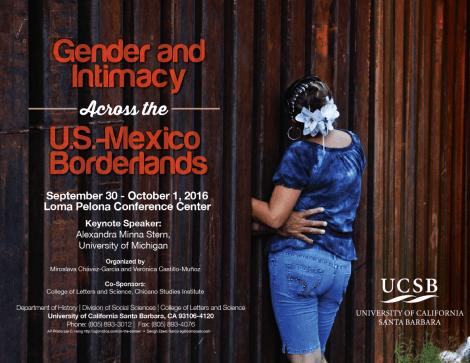
Gender and Intimacy Across the U.S.-Mexico Borderlands Conference

web_bannerCheck out the schedule for this fantastic conference presented by the University of California Santa Barbara!

September 30-October 1, 2016

For more information contact:

Miroslava Chávez-Garcia, Ph.D.

Email: mchavezgarcia@history.ucsb.edu

Tel: 530-219-3933

September 30, 2016
5:00-5:15 pm: Welcome & Introduction, Sharon Farmer, Chair & Professor, History
5:15-6:00 pm: Keynote Speaker, Dr. Alexandra M. Stern, Professor of American Culture, Women’s Studies, History, and Obstetrics and Gynecology at the University of Michigan.
6:00-8:00 pm: Catered Dinner & Informal Discussion
October 1, 2016
8:00-8:45 am: Coffee, Tea, and Light Refreshments
8:45-9:00 am: Welcome & Introductions, Miroslava Chávez-Garcia & Verónica Castillo-Muñoz

Session I
9:00-10:30 am: Cultural Studies, Media, & Personal Narratives in Contemporary U.S.-Mexico Borderlands
Laura Barraclough, Assistant Professor, American Studies, Yale University, “Charro Masculinity in Motion: Gender, Sexuality, and the Family on Hulu’s Los Cowboys”
Juan Llamas-Rodríguez, Ph.D. Candidate, Film & Media, UCSB, “The Familial Ties of the Female NarcoTrafficker”
Jennifer Tyburczy, Assistant Professor, Feminist Studies, UCSB, “Sex Toys after NAFTA: Transnational Class Politics, Erotic Consumerism, and the Economy of Female Pleasure in Mexico City”
Deborah Boehm, Associate Professor, Anthropology and Women’s Studies/Gender, Race, and Identity, University of Nevada Reno, “Divided by Citizenship and/or Geography: Partnerships in the U.S.-Mexico Borderlands”
Commentators: D. Inés Casillas, Associate Professor, Chicana/o Studies, UCSB, & Leisy Abrego, Associate Professor, Chicana/o Studies, UCLA
Audience: Comment

Session II
10:45 am-12:15 pm: Interdisciplinary Approaches to Gender, Marriage, and Intimacy in 20th-Century U.S.-Mexico Borderlands
Celeste Menchaca, Ph.D., Assistant Professor, History, Texas Christian University, “Staging Crossings: Policing and Performing Difference at the U.S.-Mexico Border, 1906-1917”
Marla A. Ramírez, Ph.D., Assistant Professor, Sociology and Sexuality Studies, SFSU, “Transnational Gender Formations: A Banished U.S. Citizen Woman Negotiates Motherhood & Marriage Across the U.S.-Mexico Border”
Jane Lily López, Ph.D. Candidate, Sociology, UCSD, “Together and Apart: Mixed-Citizenship Couples in the Mexican Border Region”
Commentators: Denise Segura, Professor, Sociology, UCSB, & Verónica Castillo-Muñoz, Assistant Professor, History, UCSB
Audience: Comment
Lunch Break: 12:15 pm – 1:15 pm

Session III
1:30 pm – 3:00 pm: Contesting Gender, Family, and Marriage in the 19th-Century U.S.-Borderlands
Margie Brown-Coronel, Assistant Professor, History, CSU, Fullerton, “History Makers in the Borderlands: Josefa Del Valle and Legacy Building in California, 1880 to 1940”
Amy Langford, Ph.D. Candidate, History, American University, “Saints on the Border: Plural Marriage and the Contest for Authority in the Mormon Colonies of Mexico, 1885 to 1915”
Erika Pérez, Assistant Professor, History, University of Arizona, “The Zamorano-Daltons and the Unevenness of U.S. Conquest in California: A Borderland Family at the Turn of the 20th Century”
Commentators: James Brooks, Professor, History & Anthropology, UCSB, & Miroslava Chávez-García, Professor, History, UCSB
Audience: Comment
3:00-3:15 pm: Concluding Remarks & Publishing Timeline
Miroslava Chávez-García, Verónica Castillo-Muñoz, & Marc Rodríguez, Editor, Pacific Historical Review


Categories: conferences, News and Announcements | Leave a comment

Peyote and the Racialized War on Drugs

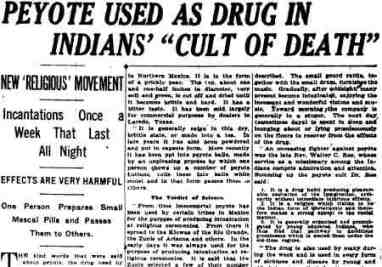
In an article  published in the Christian Century blog (here), Lisa Barnett, Ordained Minister (Christian Church, Disciples of Christ) and PhD candidate in U.S. history at Texas Christian University, discusses some of her dissertation research which looks at the ritual use of peyote by the Native American Church. Of special interest to borderlands scholars, Barnett’s research addresses how in the late nineteenth and early decades of the twentieth centuries, a commercialized peyote trade developed along the U.S.-Mexican border connecting merchants in the borderlands region of the Rio Grande to a variety of Indian tribes residing in Oklahoma and Indian Territories. In this article she examines how peyote became criminalized because of its perceived threat to Christianizing Native Americans.

newspaper-headline-nyt-1923  

                                     New York Times, 1923

Barnett writes:

“The mild hallucinogen, derived from the top of a cactus growing in the Rio Grande area, became the basis of a new American Indian religion in the late 19th century. As the peyote religion quickly spread throughout Oklahoma Territory to other tribes in the western half of the U.S., white missionaries and government officials became alarmed. In their zero-sum mindset, they viewed Peyotism as a threat to their efforts to Christianize the Native American peoples.”

Read this fascinating article at the Christian Century blog, linked here.

Categories: Essay Series | 8 Comments

Film Notes: Dread and Despair in Desierto

Desierto (2016) is a kind of horror story, and one seemingly tailor-made for this overheated US presidential election. As the Republican candidate has stoked xenophobia and recently delivered an angry speech in Arizona, this film—although imperfectly—illustrates how violence can occur when a whole group of people are denied their humanity.

Written and directed by Jonás Cuarón, Desierto tells the story of undocumented immigrants attempting to cross into the United States. It shines light on a small fragment of a much larger history of immigration in the U.S.-Mexico borderlands. From the Mexican Revolution, which saw thousands cross into the United States to escape violence, to the forced repatriation programs that the U.S. government carried out in the Great Depression, it is a history marked by individual and communal hardship. Looking further into the twentieth century, this sense of Mexican labor  as “cheap,” with workers seen as “disposable” (a subtext to the film) can be traced to the Bracero program (1942-1964), and later to the heavy economic impact of NAFTA on rural Mexican communities in the 1990s.

The film opens on a long, slow panoramic view of the Arizona-Sonora desert. A wood-panel truck carrying the immigrants stops, unable to go further. The coyotes, including one played by Diego Cataño, orders the group out to begin the rest of the trek on foot. The audience follows the story from the perspective of Moises (Gael García Bernal), who was hoping to reunite with him family after having been arrested and deported for a minor traffic violation.

Unknown to this group, a monster lurks in this desert. The audience receives its first glimpses of the villain, Sam (Jeffrey Dean Morgan), driving in a pick-up truck, listening to country music. Attached to the back bumper of the vehicle is a dusty, yellow “don’t’ tread on me” sticker. Along with his trusty dog Tracker, Sam patrols the sparse landscape, while downing hefty amounts of whisky. At one moment, he stops to chat with a Border patrol officer. After traveling deeper into the remote landscape, he comes across the small group of immigrants exhausted under the hot sun. From a distance, he takes position and with a rifle, takes aim.

It is at this moment the viewer realizes that Desierto is something very different from the quite, brooding film that opened. With a sparse script that has the actors showing their emotions on-screen more than talking through the scenes, what follows is a brutal and violent narrative. Like any horror film, the monster decimates the group with a series of swift blows, and then slowly and methodically hunts down the desperate survivors. It is bloody business, made harder to watch given the cruelty of the act. Morgan, with only a handful of words spoken during the entire film, dominates the screen and leaves one with a deep sense of dread as he prowls further into this ugly massacre.

Countering Morgan’s villainy, García Bernal delivers a strong performance. It acknowledges the desperate ordeal his character is in, while also finding a deeper strength as he tries to escape with another immigrant, Adela (Alondra Hidalgo). What ensues is a taut cat-and-mouse game across the rocky, arid landscape. The desert cinematography is captivating, and plays its own part in setting the feel of the film’s atmosphere for the audience. It is a beautiful background for what is otherwise an unrelentingly dark and violent story.

Ultimately, Desierto remains uncomfortable and deeply disturbing throughout much of its 90-minute length. Given the fraught politics of race and identity, as well as the everyday violence witnessed in communities in the United States and Mexico, the film’s exaggerated premise still felt a little too real. With its loose script, the director also leaves much of the interpretation up to the audience. We know that what Morgan’s Sam is doing is wrong, and we know that García Bernal’s Moises is the hero, but many of the scenes haunted me long after I’d left the theater. Perhaps, that was Cuarón’s intent.

Desierto-French-Poster

Desierto premiered in France and Mexico in April 2016. It will be out in US theaters in October.

Lina Murillo helped with the editing of this review. 

Categories: Films | Leave a comment

Website Built with WordPress.com.