A conversation with Marc Simon Rodriguez, author of “Rethinking the Chicano Movement” (Routledge, 2015)

In Rethinking the Chicano Movement (Routledge, 2015), Marc Simon Rodriguez surveys some of the most recent scholarship on the Chicana/o Civil Rights Movement, situating the struggle within the broader context of the 1960s and 1970s, and assessing its ethos and legacy. Illustrating the movement’s national scope, Dr. Rodriguez highlights: electoral activism in Crystal City Texas, the Farmworker Movement in the California’s San Joaquin Valley, community and educational reform efforts in Denver and Los Angeles, and the rise of Chicano media and arts throughout urban and rural communities across the country. Whereas previous generations of scholars sought to distance the Chicana/o mobilizations from the Mexican Americanist movement of the 30s, 40s, 50s, and early 60s, Rodriguez correctly asserts that El Movimiento blended practical reformist goals with a militant ethos. Youthful in character, determined to establish community control, and impatient for change, Rodriguez concludes that The Movement’s ultimate legacy was indeed profound as it established “the infrastructure to accommodate the Latino demographic revolution of the late twentieth century.”

Listen to the full conversation at the New Books in Latino Studies website, or subscribe and download via iTunes or Stitcher.

Categories: Interviews | 1 Comment

CFP: Native American and Indigenous Studies Association Annual Meeting

The Native American and Indigenous Studies Association has launched a call for paper for it’s ninth annual meeting, which will occur in Vancouver, British Columbia, from June 22-24, 2017. The organizers are accepting proposals for individual papers, panels, roundtables, and film screenings. Submissions of a broad range of diverse and interdisciplinary scholarly topics are encouraged.  More from the announcement:

All persons working in Native American and Indigenous Studies are invited and encouraged to apply. Proposals are welcome from faculty and students in colleges, universities, and tribal colleges; from community-based scholars and elders; and from professionals working in the field. We especially encourage proposals relating to Indigenous community-driven scholarship.

Visit NAISA’s conference website for additional information, including how to apply.

Categories: Calls for Papers, conferences, News and Announcements | Leave a comment

Pedagogy Notes: Teaching North American Borderlands History Online

This is the third and final installment in our summer pedagogy series. We invite you to join the discussion in our comments section at the bottom of the post.

This past summer, I taught an upper-division/graduate readings course on North American Borderlands History online for Western New Mexico University. Teaching history online presents unique opportunities and challenges. On the one hand, digital tools as simple as LMS assignment submission systems and email provide direct lines of communication with students that don’t always exist as readily in face-to-face settings where assignment feedback can often be somewhat one sided. The challenge is that although I have more direct and interactive means of discussing assignments and course concepts with students in the online classroom, they often fail to engage those opportunities.

In order to make online teaching feel less like a correspondence course, I assign Twitter, blogging, and an online timeline platform at tiki-toki.com to engage students in unique assignments that require them to use their skills of critically analyzing and discussing the monographs, articles, and primary sources that we are working on as a class. Continue reading

Categories: Essay Series, Teaching/Professional Development | 1 Comment

CFP: UTEP Borderlands History conference

The deadline for submissions to the second UTEP Borderlands History conference is approaching: September 23. The organizers invite scholars to send in proposals for individual papers and panels of 3-4 participants on a wide range of topics related to the study of borderlands. From the conference description:

This year’s theme, Shifting Borders: Gender, Family, and Community, encourages scholars of the U.S.-Mexico borderlands to explore the myriad ways social norms have been constructed, have changed over time, and have been  influenced by the unique opportunities, obstacles, and paradoxes of la frontera. This inquiry into the lives of borderlanders, though not new, is today flourishing in novel ways. Since at least the late 1970s, borderlands scholars have blended social historical approaches with borderlands history to describe the lived experiences of borderlands people. More recently, the field has shifted toward the construction of identity in the borderlands, drawing on new approaches to race and gender and paving the way for new lines of research, including new interest in communities and families. Since then, scholars have applied the tools of women’s studies and cultural history to borderlands history.

For more information, follow the link.

Categories: Calls for Papers, News and Announcements | Leave a comment

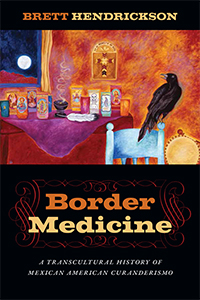
Border Medicine

Border Medicine: A Transcultural History of Mexican American Curanderismo

Brett Hendrickson (New York and London: NYU Press, 2014)

9781479846320_Full

Review by Jennifer Koshatka Seman

As students and scholars of the borderlands, we seek innovative literature and approaches to the field that can broaden not only our perspectives, but those of our students as well. Border Medicine: A Transcultural History Mexican American Curanderismo is such a book. In Border Medicine, religious studies scholar Brett Hendrickson examines the Mexican faith healing practice, curanderismo. This practice is often associated with the U.S.-Mexico borderlands because of the presence of ethnic Mexicans in this region who practice it or believe in it. Hendrickson’s study of curanderismo sheds light on another facet of the borderlands: that it is about process and hybridity, about the creation of something new… and the sometimes-unintended consequences of this.

Gloria Anzaldúa described the U.S.-Mexico borderlands as “una herida abierta,” an “open wound” created when two nations rub against each other and the less powerful one bleeds.[1] Anzaldúa also described the borderlands as a place where new, hybrid cultural practices and identities are born because of the intersection of different peoples, ideas, and cultures in this space: “And before a scab forms it hemorrhages again, the life blood of two worlds merging to from a third country – a border culture.”[2] In Border Medicine, Hendrickson addresses the cultural combination that created curanderismo and the ways in which it appeals to a wide audience even beyond the borderlands. He argues that although curanderismo has historically been most closely associated with Mexicans and Mexican Americans, it has always possessed a strong appeal to Anglo Americans. Hendrickson explains, “curanderismo’s intrinsic hybrid nature opens up multiple channels of convergence with other energy-based healing modalities common in American metaphysical religion” (3). Border Medicine illuminates these “channels of convergence.”

Continue reading

Categories: Book and Journal Reviews | 1 Comment

Special Publication–Global Border Studies (IJCEAS)

Stemming from the 2014 Berlin Border Seminar, the Comparative Research Network has published the first of a two-part special edition of the International Journal of Contemporary Economics and Administrative Sciences,“Implications of Borders on Culture and Economics.” The publication features a wide range of interdisciplinary border studies projects, including one of my own, “Spirit, Transformation, and Gender in Borderlands: A Representative Case Study.”  It’s free to access, so check it out here.

Screen Shot 2016-08-05 at 9.13.15 AM.png

The cover features the Oder River near the campus of the European University Viadrina, separating Frankfurt (Oder), Germany and Slubice, Poland.

Categories: News and Announcements | Leave a comment

Pedagogy Notes: On Thinking about Borderlands in World History

This is the second installment in our pedagogy series. We invite you to join the discussion in our comments section at the bottom of the post.

At CIDE Región Centro, in 2014, when I started teaching my World history I course, I wanted to incorporate a Borderlands history perspective into my lectures and class discussions. Imperial frontiers is a topic that I have long found fascinating, and now given the chance, I wanted to explore it further with students. One of my favorite readings on this subject, which I assigned to students for group discussion, was Porfirio Sanz Camañes’s “Frontera, límites y espacios de confrontación en la América Hispana durante el siglo XVIII.” In it, Sanz examines the conflicts that occurred in the region of Río de la Plata before a new treaty was signed between Spain and Portugal. Sanz considers how the concept of the “frontier” and “border” evolved during the colonial period. It’s a great essay that also helped me conceive my lectures on the colonial empires in South America.

Another reading that has been very useful in conceptualizing borders and frontiers in my World history class is Nelson Eduardo Rodríguez’s “El imperio contraataca: las expediciones militares de Antonio Caballero y Góngora al Darién, 1784-1790.” Rodríguez contextualizes the Darien region of Panama as a colonial frontier where indigenous people and smugglers resisted and bedeviled settler officials who tried to subject the region to the crown’s authority. Throughout the eighteenth century, this porous “borderland” pertained and became a site Great Britain exploited to pressure the geopolitical power of their Spanish rivals in the western Caribbean.

Many of the students who I teach grew up in central Mexico and the region of the Bajío, which includes the state of Aguascalientes, where I live and work. When I’m developing my classes on New Spain, David Weber’s work, especially Bárbaros: Spaniards and Their Savages in the Age of Enlightenment, remains an important resource for writing and revising lectures. The discussion of frontiers that Weber uses really helps me to add an appreciation of “empire” as a process constructed through cultural and economic change as well as the application of violence to subject indigenous people to colonial power. In this context, I emphasize to the class the critical role that the Bajío played in facilitating the deployment of Spanish power to northern New Spain.

Likewise, Peter Sahlins’s excellent, Boundaries: The Making of France and Spain in the Pyrenees, has been very useful when I’m covering the development of nation-states. I urge students to identify the historical context of creating borders and the often bloody impact of this work. One of my favorite moments during the semester is when students really grasp the constructed and artificial character of the nation-states that we consider to be almost “timeless” monolithic entities.

Ultimately, I want to use the themes of borders and frontiers in World history to help students conceptualize the political relationships that marked the early modern world and gradually influenced the evolution of nation-states. I see it as an opportunity to connect present-day debates around borders and migration to the historical context of these issues in the colonial period. In this sense, a Borderlands history perspective has helped me to make connections across different regions and time periods in the lectures and discussions we have in the course.

Categories: Teaching/Professional Development | 2 Comments

A Conversation with Roberto Lint Sagarena, author of “Aztlan and Arcadia: Religion, Ethnicity, and the Creation of Place.”

The (re)making of place has composed an essential aspect of Southern California history from the era of Spanish colonialism to the present. In Aztlan and Arcadia: Religion, Ethnicity, and the Creation of Place (NYU Press, 2014) Associate Professor of American Studies at Middlebury College Roberto Lint Sagarena examines the competing narratives of Anglo American conquest and ethnic Mexican reconquest following the U.S. War with Mexico in the mid-19th century. Employing a transnational lens that illuminates the commonalities between Spanish colonizers, Mexican criollos, Anglo American settlers, and ethnic Mexican Californians, Dr. Lint Sagarena argues that the ethno-nationalist histories of Aztlan and Arcadia share commonalities in logic, language, and symbolism that are rooted in religious culture and history. From Anglo American Hispanophilia to Chicana/o indigenismo, Professor Lint Sagarena sheds new light on the region’s long and conflicted history over its multi-ethnic past as well as the understanding by many of its inhabitants that “owning place requires owning history.”

Listen to the full conversation at New Books in Latino Studies or via iTunes and Stitcher.

Categories: Interviews | Leave a comment

Pedagogy Notes: On Recent Books and Teaching

As many of our readers are planning for next semester’s classes this summer, we’ve decided to launch a new summer series for ideas on teaching Borderlands history and historiography. Tim is starting us out with this article today, and we hope to have additional essays on the subject as the month continues. You’re also welcome to share your own experiences or insights on Borderlands pedagogy in the comments section at the bottom of this post. -Mike

One of the most rewarding aspects of working in Borderlands history is that that the field is ever-evolving; this, however, can also be something of a problem. Given the tremendous numbers of exciting new books and articles that are published on an annual basis, it can be difficult for any historian to stay on top of all of the new contributions that scholars make to the field. One solution that I have found (and I’m certainly not alone in this) is that it is often useful to put articles and monographs on my syllabi before I have actually read them. This, of course, is inherently dangerous—what if the book or article in question doesn’t translate well to the classroom, or, what if you find the material less than satisfactory but still have to figure out a way to teach it? Inevitably, this will happen from time to time.

Having now taught both graduate and under-graduate level seminars on Borderlands history within the last year, I wanted to take the time reflect on a handful of new monographs that I have used in the classroom and to reflect a little bit on the pedagogical value of said books. Given the premium placed on space in a short blog post, I will restrict my discussion to those works that have been published since early 2015 in particular, which is somewhat problematical given the field’s constant vitality (I should also note that this list is obviously not an exhaustive one—there are many new monographs aside from the few that I will discuss here that are absolutely worth reading or assigning to students).[1] Nonetheless, the field saw a number of exciting new works in 2015 that Borderlands scholars might want to consider adding to their syllabi in the near future.

One book that I have had great recent success with is Andrew Torget’s, Seeds of Empire.[2] Torget’s book is, quite simply, a necessity for people interested in the easternmost edges of the U.S.-Mexico borderlands; given that it recounts some of the most iconic moments in early-nineteenth century Texas history, I would strongly encourage Borderlands historians who teach in Texas, in particular, to consider adopting this book. To quote Torget, Seeds of Empire shows how

[p]owerful economic and political forces swirling the north Atlantic crashed into one another…swept across the continent, and transformed Mexico’s northern borderlands into the western edge of the U.S. South…That process would, in time, redistribute power on the continent as it remade the border between the United States and Mexico, leaving both countries with enduring tensions that reverberate to this day.[3]

Importantly, these forces in question—U.S. expansion, the slavery complex, and the transatlantic cotton economy—not only shaped the eventual establishment of the U.S.-Mexico borderline, but Torget’s highlighting of these economic and political factors shows how the deployment of Borderlands analysis can fundamentally alter certain long-existing historiographical notions; in this case, Torget provides a fresh interpretation of events such as the Texas Revolution, Texas annexation and the U.S.-Mexico War, sweeping away longstanding historiographical debates such as the oftentimes anachronistic and downright silly explanations that previous generations of historians have provided for events such as the Texas Revolution.[4] Seeds of Empire thus provides a clear and compelling example of the promise of Borderlands analysis to undergraduate and graduate students alike, replete with historical events and phenomena that students will easily grasp, if they are not already entirely familiar with them (this, again, is particularly likely at Texas-based institutions, for obvious reasons).

If Seeds of Empire can successfully help students to see the usefulness of Borderlands history, other books published since 2015 highlight borderlands phenomena that have been mostly overlooked in the literature up to this point. For example, Borderlands historians have of late begun to pose a number of questions related to state power and borderlands political economies. To that end, another monograph published in 2015 that clearly and nicely illustrates the promise of Borderlands history for students is George Díaz’s, Border Contraband. Díaz’s study of smuggling in the Texas-Mexico borderlands highlights relations between the state and the local: “when governments regulated and prohibited trade on their borders,” the author writes, people consequently “subverted state and federal laws through smuggling.”[5] Furthermore, the definition of what governments consider illegal oftentimes runs in counterdistinction to what borderlanders consider wrong, thus creating a moral economy that in reality can only exist at the margins of modern nation states.

Border Contraband serves as an excellent conversation starter about the nature of the relationship between the federal government and borderlanders, along with providing a clear focus on the lived experiences of the latter. Also, this book works well in the classroom because the subject matter is, put simply, cool. A well constructed and readable book on a cool subject like smuggling will have no difficulty in piquing the interests of students in a classroom setting (this was certainly the case in my own personal experience).

One important issue related to questions of agency and the state is the reciprocal relationship between border crossing, border control and the influences of state formation on people at the margins. For a nice example that works well for the U.S.-Canada borderlands, in particular, see Michel Hogue’s, The Metis and the Medicine Line.[6] The border, in Hogue’s view, actually gave life to the Metis. Hogue refers to the 49th parallel as “the medicine line” for the Metis, meaning that it was a source of strength and collective group identity for them in the face of intrusions by the Canadian and U.S. governments. Comparatively, Hogue’s book pairs nicely with Díaz’s, given that both reflect border developments in the face of state power.

Indeed, the Metis—a group consisting of people of First Nations, Native American, and Euroamerican ancestry—emerged in Canada during the nineteenth century as a people “in-between,” which fact alone makes them a fascinating study of cross-cultural interaction (one of the many facets of Borderlands history). The Metis absorbed other groups, their material goods, and crossed the 49th parallel as an expression of group agency and self determination; crossing the border also drew out contradictions in the settler colonial projects of the United States and Canada as well as their different laws, which in turn led each nation state to assert its sovereignty over the joint borderline to greater degrees during the late nineteenth and early twentieth centuries. The Metis in Hogue’s study are thus somewhat reminiscent of certain actors in Richard White’s classic, The Middle Ground, but the difference here is that these people also had a clear influence over—and, in turn, found themselves influenced by—two modern nation states. As such, The Metis and the Medicine Line is filled with questions related to identity, borders, political economy and state power—in short, this book covers some of the fundamental questions of Borderlands historiography writ large. Admittedly, Hogue’s book is a slightly more challenging read than either Torget’s or Díaz’s, but the payoff in any class about borders or borderlands is, I think, readily apparent.

Fortunately, Borderlands historians continue to tackle issues that are relevant to contemporary society: few issues are more relevant and newsworthy—especially during the vicious 2016 election cycle—than Mexican immigration (if for no other reason than the cacophony of shrill voices calling for restrictions from the Donald Trump camp). John Weber’s book, From South Texas to the Nation, traces the origins of Mexican labor exploitation throughout the twentieth century. Weber’s argument is twofold: first, he argues that Anglos and ethnic Mexicans fashioned an agricultural empire in early twentieth-century South Texas; and, secondly, he argues that this agricultural empire served as a laboratory of sorts for other employers across the United States, who copied the “South Texas model of labor relations” in order to exploit workers and pad their own profit margins.

The usefulness of Weber’s construction, of course, is that it puts on full display connections between the border and Mexican immigration with which students are more than familiar. Borderlands history thus is shown to have clear and deep contemporary relevance in this particular case. Weber’s book is also a good reminder of the value of smart Borderlands history on twentieth-century topics; in my case, students responded well to the book and saw connections between scholarship and current affairs. A few of my students, in fact, were comfortable and inspired enough to speak up during class discussions about their own experiences being undocumented immigrants.

Ultimately, the greatest challenge that any Borderlands historian will face over the course of her or his career is staying on top of the literature; nonetheless, a flexible approach that incorporates as many of the latest articles and monographs as possible not only allows one to keep reading, but it also helps convey the conceptual shifts that the field constantly experiences. But most importantly, these four books illuminate some central conceptual concerns in Borderlands history that students, simply put, must understand, including but not limited to the importance of transatlantic political and social economies; community-level political or moral economies in the borderlands and their relationships to the nation state; the reciprocal relationship between border making and the foundation of individual or group identity; and finally, the borderlands as a human laboratory for racial and labor exploitation.

All of the above concepts are crucial to understanding some of the latest insights that Borderlands history has to offer. I sincerely hope that some readers will consider using these books in classes during the upcoming year (or years). I would also like to invite a little bit of dialogue here: readers who have utilized the above-mentioned books are welcome to respond in the comments section of this post about their own experiences in using them. Also, what recent titles have you used in your courses that you would recommend to others in the field? History, at its best, is a conversation—let’s have one!

NOTES

[1] For just a few examples, see, Alicia M. Dewey, Pesos and Dollars: Entrepreneurs in the Texas-Mexico Borderlands, 1880-1940 (College Station: Texas A&M University Press, 2014); Kornel Chang, Pacific Connections: The Making of the U.S.-Canadian Borderlands (Berkeley: University of California Press, 2012); and, Geraldo Cadava, Standing on Common Ground: The Making of a Sunbelt Borderland (Cambridge: Harvard University Press, 2012).

[2] Andrew Torget, Seeds of Empire: Cotton, Slavery, and the Transformation of the Texas Borderlands, 1800-1850 (Chapel Hill: University of North Carolina Press, 2015).

[3] Ibid., 3.

[4] Many of these are covered in an excellent book by historian James Crisp. For more, see, James Crisp, Sleuthing the Alamo: Davy Crockett’s Last Stand and Other Mysteries of the Texas Revolution (Oxford: Oxford University Press, 2005).

[5] George T. Díaz, Border Contraband: A History of Smuggling across the Rio Grande (Austin: University of Texas Press, 2015), 1.

 

Categories: Teaching/Professional Development | 2 Comments

Black Lives Vigil on the Border

In El Paso, The Black Student Union (BSU) from The University of Texas at El Paso (UTEP)and the group Parents, Families, and Friends of Lesbians and Gays (PFLAG) hosted a vigil in memorial of Black Lives lost to unnecessary violence and to educate the community of the ongoing tragedies across the nation.

The community gathered at La Plaza de los Lagartos (San Jacinto Plaza) in the evening on Sunday, July 10. The plaza was filled with various organization and community members who stood in solidarity with BSU and PFLAG. Among the attendees were students from New Mexico State University who made a special trip to El Paso from Las Cruces, New Mexico to attend the vigil.

The press release circulated for this event  read “Black Student Union, BSU, is to promote activities of common interest, cultural and educational benefits for the African American students at UTEP,” it went on to quote the organizations president Shyla Cooks, “We have been far too silent for far too long.”

Organizers and leaders of the Black Student Union (BSU) Keyanna Robinson, Makeda Buggs, and Shyla Cooks shared a few words please click on their names to hear their message. These brave students continue the long legacy of community organizing and activism on the border. Through poems, speeches, and songs they joined their voice to the many speaking out about injustices faced by black communities and other minority groups across the United States.


IMG_3107

Makeda Buggs, Black Student Union (on stage speaking)


Categories: Events, News and Announcements | Leave a comment

Website Built with WordPress.com.