CFP: 2016 Inter-American Relations Conference

Dear readers, the Eugene Scassa Mock Organization of American States Program has launched a call for papers for its first annual  academic conference. This year’s theme is “Inter-American Relations: Past, Present, and Future Trends.” The conference, which will be held at Texas State University in November 2016, is open to undergraduates, graduate students, and faculty to participate. Topics can cover any subject on Inter-American historical, political, or cultural relations. The deadline to submit your 250-abstract is June 20th. For more information on the conference and instructions on how to submit, follow the link:

ESMOAS Conference website


Categories: Calls for Papers | Leave a comment

Bloodlines and Borderlines in Louisiana: Grappling with Cajun Identity in Borderlands History

This entry is the first in a series that Jessica will be writing for the blog about her personal and professional journey developing and researching her dissertation topic as a doctoral candidate in Borderlands history. She welcomes all constructive feedback in the comments section and hopes to spark a broader conversation about identity and regional borders over the coming months. -ed

About midway through my dissertation proposal defense, Dr. Jeff Shepherd, my dissertation chair at the University of Texas at El Paso, asked: “how does your project fit into Borderlands history.”  I was not surprised by the question, but I remained stumped for some reason and gave a canned response. His question lingered after I became ABD. How does your project fit into Borderlands history, or a problem like it, is a question on every graduate student’s mind who studies in this field.

As to why I am struggling with this question may have to do with my topic, Cajun history, in particular, Cajun identity.  Cajun history begins with the early French Acadian settlements on the tidal flats of present-day Nova Scotia.  Imperial competition grew and in 1755, the British expelled the French Acadia settlers and scattered them throughout British North America, Caribbean, South American coast, the Falkland Islands, or France.  After that, many Acadian exiles residing in France traveled to Louisiana and were welcomed under the Spanish crown hoping to increase the territory’s population. Continue reading

Categories: Essay Series, Teaching/Professional Development | 1 Comment

CFP: SMU Dissertation Writing Workshop

Dear readers, we wanted you to know about a great upcoming opportunity for graduate students. The Clements Center at Southern Methodist University has launched a call for papers for its 11th annual Western History Dissertation Workshop. It will be held on Saturday, May 28, 2016, at the university’s satellite campus in Taos, New Mexico in conjunction with a number of partners, including the Lamar Center for the Study of Frontiers and Borders at Yale University and the Center for the Southwest at the University of New Mexico, among others.

image

Graduate students who are at an advanced stage in writing their dissertations are encouraged to apply. Topics can include any aspect of the history or culture of the American West. The workshop organizers will fly five students to Taos, expenses paid, to participate and receive feedback from the group as well as senior scholars. Continue reading

Categories: Teaching/Professional Development | Leave a comment

Border Studies Summer Program in Japan: Call for Applications

Dear readers, Hokkaido University in Japan is accepting applications for participants in its border studies summer program. The university’s Graduate School of Public Policy and the Slavic Eurasian Center will host the summer school in Saporro from 25-28 July, and it is open to studies from all over the world. Sessions will cover thematic and geographic topics, from studies of borders in Europe and Asia to gender and diversity and representations of borderlands in art.

The deadline to apply is 28 February. For more information, follow the link:

Border Studies Summer School, Hokkaido University:
http://src-h.slav.hokudai.ac.jp/ubrj/eng/whats-new/archives/201602/05221.html

Categories: News and Announcements | Leave a comment

Public Lecture: Bill Beezley at NMSU

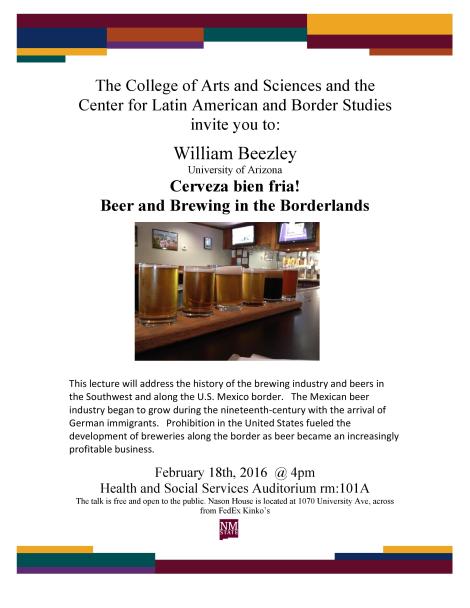
On February 18th, Bill Beezley will be giving a public lecture at New Mexico State University, sponsored by the Center for Latin American and Border Studies. He’ll be speaking on the history of the beer industry in the Mexico-US borderlands. If you’re going to be in the area, check it out! We’ve attached the event flyer.

Bill Beezley, Feb 18th-page-001

Categories: Events | Leave a comment

CFP: 2016 Visual history conference in Mexico City

The Department of Social Sciences and Humanities at Mexico City’s Universidad Autónoma Metropolitana Unidad Iztapalapa has an open calls for submissions for an upcoming conference. The theme for the gathering is “the image as a source for History.” The conference looks to develop interdisciplinary approaches to the study of visual history. The deadline to submit proposals is March 4 and the conference is scheduled to occur from May 16-18.

For more information, we’ve attached the event flyer:

image

Categories: Calls for Papers | Leave a comment

Embracing Transnationalism and Rethinking Fundamentalisms: A Review of the Borderlands and Frontiers Studies Committee Meeting at the 130th AHA Annual Conference


12467964_10102551869180831_1762887116_n


Embracing Transnationalism and Rethinking Fundamentalisms

A Review of Frontiers of Borderlands History: Gender, Nation, and Empire – The Borderlands and Frontiers Studies Committee Meeting at the 130th AHA Annual Conference, Friday, January 6th in Atlanta, Georgia.

Participants: Elliot Young, Omar S. Valerio-Jiménez, Sonia Hernández, Julia Maria Schiavone Camacho, and Ramón A. Gutiérrez

Borderlands history is the study of a particular region – the U.S.-Mexico borderlands (for most of those attending this panel) – but it also might be more broadly conceived as the study of transnational processes that transcend borders. The chair of the Borderlands and Frontiers Studies Committee Meeting, Elliot Young (Lewis and Clark College) has demonstrated in his first monograph, Caterino Garza’s Revolution on the Texas-Mexico Border (2004), that borderlands history is at once tied to a specific region, but can also transcend it, as his recent monograph, Alien Nation: Chinese Migration in the Americas from the Coolie Era Through WWII (2014) shows. Unfortunately, I missed Elliot Young’s opening remarks due to the trouble I had navigating the vertical maze of the Marriott – one of the three enormous hotels claimed by the AHA last weekend.

I arrived while Omar S. Valerio-Jiménez (University of Texas at San Antonio) was talking about both the necessity and difficulty for borderlands historians to complete research in archives on both sides of the border, something he experienced while researching his monograph, River of Hope: Forging Identity and Nation in the Rio Grande Borderlands (2012). This theme, the importance of transnational archival research, came up in each paper. In fact, two overarching and overlapping questions emerged from this panel discussion. First, how is borderlands history “transnational” and what does “transnational” mean? Second, does borderlands history challenge cultural and national “fundamentalisms” and binaries or reinforce them? Continue reading

Categories: conferences, Methodology | 1 Comment

CFP: Citizenship and migration conference, deadline extended

Dear readers, happy new year! We wanted to let you know that the call for papers deadline has been extended for an upcoming conference on citizenship and territory between Asia and North America during the nineteenth century. The deadline is now January 31, and the conference, titled “Traffic, Territory, Citizenship: Framing the Circulation of People and Goods between Asia and the Americas in the Long 19th Century” will be held at Binghamton University from April 15-16. From the notice:

The symposium will feature two keynote sessions, led by guest senior scholars Madhavi Kale (Bryn Mawr College), a historian of Indian indentured labor migration and Indian domesticity, and Robert Hellyer (Wake Forest University), a historian of international trade in Japan and the global tea trade.

Open to any discipline, the symposium will combine sessions organized around questions drawn from participants’ research with presentations on primary sources. In addition to discussion and feedback on their research, participants will also collectively produce a digitally-annotated bibliography of relevant scholarship and a digital archive of primary sources – both to be published online as an integrated exhibit to spur future research and support teaching on the workshop’s themes.

For more information, follow the link:
https://networks.h-net.org/node/23910/discussions/104945/cfp-deadline-extended-131-traffic-territory-citizenship-framing

Categories: conferences | Leave a comment

A conversation with Laura Isabel Serna, author of “Making Cinelandia: American Films and Mexican Film Culture Before the Golden Age.”

During the early decades of the 20th century the nation of Mexico entered the modern era through a series of social, political, and economic transformations spurred by the Mexican Revolution of 1910-1920. At the same time, American film companies increasingly sought opportunities to expand their market share by exporting films to exhibitionists in Mexico and Latin America. As government bureaucrats and progressive reformers sought to unify and rebuild the Mexican state, the cinema became a critical site through which the post-revolutionary ideals of modernization, secularism, and ethnic nationalism were promoted.

In Making Cinelandia: American Films and Mexican Film Culture Before the Golden Age (Duke University Press, 2014), Associate Professor of Critical Studies in the School of Cinematic Arts at the University of Southern California Laura Isabel Serna vividly describes the process of cultural exchange that played out across the U.S.-Mexico borderlands during this critical period in the development of the modern Mexican state. Focusing on the “agency of Mexican audiences, distributers, cinema owners, and journalists,” Professor Serna narrates the dynamic process of how American film was received, interpreted, and fashioned to meet the needs of Mexican state officials and a “transnational Mexican audience.” Illuminating alternative responses to Mexicana/o “encounters with American mass culture” that did not always result in the acculturation of American values, Dr. Serna argues that movie going promoted a growing sense of Mexican national identity among the emerging diasporic community of transnational Mexican citizens in the post-revolutionary era.

Listen to this conversation in full at New Books in Latino Studies.

Categories: Interviews | Leave a comment

BHIP #6: A Conversation with Dr. Maria Montoya


Montoya2013

Join me in welcoming Dr. Maria Montoya to the BHIP as she helps us bring this fantastic year for the Borderlands History Blog to a close. I was fortunate to meet with her at the Western History Association conference in Portland, Oregon. It was a chilly morning in late October when I sat with Professor Montoya to discuss her research, teaching, and new projects. We discussed the convergence of Western and Borderlands history in her work and teaching. Dr. Montoya is currently Associate Professor of History at New York University. She received her M.A. in 1990 and her PhD in 1993 from Yale University.

Dr. Montoya has written extensively on the history of the American West and borderlands. Her first book Translating Property: The Maxwell Land Grant and the Conflict Over Land in the American West, 1840 to 1920 about the various state and capitalist forces that altered the American landscape after 1848 received excellent reviews, she has several articles and chapters in edited volumes including one with Vicki Ruiz and John Chavez, titled “Creating an American Home: Work, Gender and Space in Rockefeller’s Coal Towns.” Her second manuscript titled: Taking Care of American Workers: The Origins of Universal Healthcare in the American West 1900-1950 and a text book Global Americans: A Social and Global History of the United States are both forthcoming. We talked about what inspired her research and her teaching, and how borderlands history and methods have influenced how she engages her scholarship. Continue reading

Categories: Interviews, Uncategorized | Leave a comment

Website Built with WordPress.com.