Conference Notes: LASA 2016

At the end of the spring semester, I had the opportunity to attend and present my work at this year’s Conference of the Latin American Studies Association in New York City. The meeting brought thousands of specialists of Latin America to the Big Apple’s Midtown Hilton and Sheraton Times Square hotels. I landed in JFK on Thursday late afternoon and took an Uber into the city. Checking into my hotel in the West Village that evening, I made it to the conference site at the start of the next day. Already the Hilton lobby was packed with attendees for a full schedule of panels and other events over Memorial Day Weekend. In total, more than six thousand people participated in this year’s LASA with over 1,400 panels listed in the program. The conference’s film festival also screened dozens of works.

Bustling Times Square, photo by author.

For historians of the U.S.-Mexico Borderlands, there were a handful of interesting bilingual panels presenting papers on mobility, immigration policy, cultural and social analysis, drug policy, and historical memory of the region. On Friday morning, Amelia A. Hall of the University of Alberta was scheduled to give her paper, “The Badasses of Bad Movies: Border Hybridity, Women’s Models, and Gendered National Identity in Cine Fronterizo.” Unfortunately, it was difficult make it to everything given that a lot of related panels were occurring at the same time. Down the hall, Marta M. Caminero-Santangelo, of the University of Kansas, had organized a panel on literary depictions of border crossings, which looked at the DREAMers, as well as the Caribbean context of the border (Marisel C Moreno, University of Notre Dame), and Latinx literary aesthetics (Ylce Irizarry).

Of course, being New York City in springtime, there were countless things to do outside the hotel’s walls. Walking through midtown Manhattan, people wearing their attendee badges could be seen enjoying all that the area had to offer. Although the heat was sweltering, I joined friends for walks in Central Park, strolled Fifth Avenue, and later had dinner nearby the conference at the tasty and affordable, Topaz Thai.

The next day, I was excited to attend an early evening panel organized by Stanford University’s Mateo J. Carillo, and chaired by Julia G. Young of the Catholic University of America, on transnational migrant mobilities. Being an historian of transport mobility in northern Mexico, myself, this session was right up my alley (pun intended). The first presenter, Laura D. Gutierrez from the University of California-San Diego, spoke on the history of the Bracero program and punitive deportations. One aspect of the work that really captivated my interest was Gutierrez’s analysis of the power and limits of the U.S. and Mexican bureaucracies that exerted power over transnational workers. Following Gutierrez, Carillo spoke about the history of road building in the Bajío, a northwest-central region of Mexico, and its impact on the mobilization of agricultural workers who traveled for jobs in the United States. Carillo rightly emphasized that new roads played a crucial role in this labor history from the 1940s to the 1960s. Lastly, Yuridia Ramirez of Duke University, presented her work on the links that form between Mexican migrant communities in North Carolina and their families and friends remaining in the Bajío. She analyzed themes of identity production and cultural heritage, and the role that education played. The discussion that followed was lively. Afterwards, I joined colleagues for dinner at the aptly named House of Brews.

My panel, organized by my friend and colleague Catherine Vézina of the Centro de Investigación y Docencia Económicas (CIDE), was scheduled for Monday morning in the Times Square Sheraton. It began with José Alberto Moreno Chávez of El Colegio de México (Colmex) who spoke about cosmopolitan culture and modernization in Mexico City through a fascinating analysis of how elites wrote and thought about popular terms, including “Snob” and “Fresa,” which invariably included historical context of U.S. cultural influence. I followed with a presentation on rural road-building campaigns in Mexico, including the northern Mexican state of Nuevo León, where transportation companies pressed the government for more highways in support of domestic and U.S. tourism along the border. Catherine continued, giving a paper on the implications of the bracero program to bilateral policy initiatives and questioning the impact on modernization schemes in Mexico. After her, Valeria Sánchez Michel, also of CIDE, discussed the history of modernization related to Mexican higher education in the 1950s, exploring the cultural representations that planners hoped to impose as well as how this ideal contrasted with students’ everyday life and demand for reforms. Finally, Colmex’s Vanni Pettina concluded the panel with a lively discussion of his work on bilateral relations between the Soviet Union and Mexico during the late 1950s and early 1960s as Mexican President Adolfo Lopéz Mateos navigated the diplomatic currents of the Cold War.

Following the panel, it was time to grab a coffee, check into some other sessions, meet more friends and colleagues, and later explore more of the city. The weekend was packed and like any LASA conference, it’s hard to make it to every panel and event that piques your interest. Nevertheless, it was a great experience that brought together a wide gathering of the academic community on Latin America in a diverse, multicultural and multidisciplinary atmosphere. If you were at LASA this year, share your experiences about the panels (especially borderlands-themed sessions) in the comments below!

Categories: conferences, Events | Leave a comment

Vigilia por la Paz en Oaxaca

Last night in El Paso, Texas educators, students, and community organizers gathered at the Plaza de los Lagartos (San Jacinto Plaza) to show support and solidarity with the teachers in Oaxaca, Mexico. Many shared their thoughts about the injustice that continue happening in Mexico and the ones threatening our community on the border.

In a time of great tragedy and suffering across the world, we cannot forget the violence also occurring in Mexico. The people assembled at the gathering strongly supported the declacation, “En México la educación se paga con la vida! Alto a la represión en Oaxaca!”

Categories: Events | Leave a comment

Philosophy for Children in the Borderlands

This week the El Paso Herald-Post online featured University of Texas at El Paso, Assistant Professor Amy Reed-Sandoval’s Philosophy for Children program. Reed-Sandoval began the Philosophy for Children program on both sides of the border in 2014; working with children in Oaxaca, Mexico, Ciudad Juarez, Mexico and El Paso.

“One of the primary goals of this documentary is to explore the ways in which the social, linguistic, political and historical contexts of the Mexico-U.S. border–and particularly El Paso and Ciudad Juarez–impact the sorts of philosophical questions that local children and community partners seek to answer,” Reed-Sandoval said.

Categories: Events, Exhibits, Films, Teaching/Professional Development | Leave a comment

CFP: Not Just Green, Not Just White: Race, Justice, and Environmental History

Not Just Green, Not Just White: Race, Justice, and Environmental History

 Eds. Traci Brynne Voyles and Mary E. Mendoza

CALL FOR PAPERS: In 2003, Carolyn Merchant called on environmental historians to redouble their efforts to craft a critical environmental history of race, particularly one that takes into account the vast and urgent stakes of environmental injustice for communities of color. Not Just Green, Not Just White seeks to answer that call, highlighting scholarship that engages our environmental past with an eye toward building socially and environmentally just futures.

This collection brings together voices that analyze the relationships between environment, race, and justice through a historical lens, exploring how environmental injustices are produced in different historical contexts in ways that profoundly shaped, and still shape, the experiences of communities of color in the US. More broadly, these collaborators ask how power relations have been articulated through resources and resource exploitation; how the environment has been a literal and figurative terrain of struggle over rights, inclusion, or differentiation; or how nature has come to signify and symbolize race in ways that produce unequal or unjust power relations. Ultimately, the collection seeks to underscore the reality, long apparent to communities of color but too rarely articulated in scholarship on environmental history, that racial injustice and environmental degradation (and sometimes preservation) are co-constituted.

Race is a critical component to the study of environmental injustice, but environmental history, until very recently, has tended to leave out questions of race. Classic environmental histories have focused on wilderness, whiteness, and white ideals of pure nature, leaving unexamined the different ways in which people of color experience the nonhuman world and engage in environmentalism. This tendency in environmental history reflects dominant American narratives that focus on white individuals and how they have changed landscapes, ignoring how expansion, settler colonialism, economic and agricultural development, resource extraction, and urban planning have dramatically affected the relationship between people of color and their own natural and built environments. This, in short, is a totalizing, universalizing framework that flattens the diversity of human relationships to the non-human world. This collection brings together a number of historians thinking about a range of environmentalisms and environmental histories, with an eye toward building a more environmentally just future – as well as piecing together a more complete picture of our diverse environmental pasts.

The lack of exchange between environmental justice and environmental history goes both ways, and both fields of scholarship can compliment each other in productive ways. Contrary to environmental history, environmental justice scholarship has been focused on contemporary cases of environmental injustice and racism, only infrequently accounting for the rich histories that produce and give form to unequal relationships to resources and environmental protection. Still, many environmental justice studies of gendered and raced environmental epistemologies have added significantly to our understanding of how environmental knowledge and experience are more rich and more complex than simple reductions to “man’s” impact on “nature.” This collection seeks to apply that rich scholarship, with its deep thinking about race as an analytic as well as about the lived realities of people of color, to environmental history in ways that can bring us to a better understanding of the connections between humans and nature, as well as between and within our human communities. As part of this move toward deep thinking about race and diversity, we are attuned to the need for more intersectional applications of this scholarship, looking to the ways in which gender and race (and sexuality and class) together have formed our relationships to the non-human world not only in the present and future, but also in the past.

We will consider historical scholarship that seeks to explore what the human relationship with nature has looked like for various communities and indigenous nations across the US. We are particularly interested explorations of how (white, American notions of) environmentalism, or activities associated with it, have reinforced racial and classist stereotypes by alienating people who cannot afford or who cannot access things like recycling, or buying local organic foods, and excluded the diverse environmental epistemologies and practices of people of color from mainstream environmentalism. Additional avenues of inquiry might look at the ways that diverse communities and peoples have interacted with nature and what it means (or has historically meant) to be good stewards over nature. Ultimately, we hope to bring together a range of scholars working to disentangle whiteness from environment and environmentalism, and in doing so, offer a more diverse approach to our environmental past, present, and future. Continue reading

Categories: Calls for Papers, News and Announcements | Leave a comment

Essay Series: New & Upcoming Topics in Borderlands History

Dear readers, we’re launching a new series to spotlight the work of early-career faculty and PhD students in Borderlands History. We’d like to introduce our first participant, Jonathan Cortez, who studies at Brown University. He’ll also be joining us as a regular contributor to the blog! -Mike

Hi Everyone!

My name is Jonathan Cortez and I am currently a doctoral student in American Studies at Brown University. I am also completing requirements towards a Master’s in Public Humanities from the John Nicolas Brown Center for Public Humanities and Cultural Heritage. I received my B.A. in Latina/o Studies and Sociology from The University of Texas at Austin. My hometown of Robstown, Texas and its community continuously serve as sources of inspiration for me as I move through academia. Specifically the absence of local and ethnic histories from my K-12 public schooling resulted in retroactive self-seeking that has led me to write histories of Robstown, South Texas, and the larger U.S. Southwest areas.

My research trajectory began with recovery of personal histories. I learned about the Chicana/o Movement’s importance in Robstown after conducting oral histories with family members. Under the guidance of Dr. Emilio Zamora, I conducted research and wrote “Occupying La Lomita: Claiming Chicana/o Space and Identity in Robstown, Texas” as my Latina/o honors thesis. “Occupying La Lomita” was awarded the NACCS Frederick A. Cervantes Undergraduate Student Premio in 2015 in San Francisco, California.

My current research focuses on twentieth century transnational rural social movements along the U.S. Southwest. Specifically I have taken interested in the history of labor camps from the 1930s – late 1960s. My most recent academic papers examine multiracial labor streams of Mexican, Black, Native, Asian, and White laborers in Farm Security Administration (FSA) migratory labor camps. I use archival newspapers, photos, and oral histories to recount processes of racialization between different racialized groups in the same labor camps. I also write about the cultural representation and memorialization of labor camps and laborers in current discussions of race, class, gender, and immigration status.

I also consider myself a public historian and continuously work with my own community to foster pride in local history. I am working with the Robstown Area Historical Museum to develop an event, to which I am the project director, called “Community History Day” that allows community members to add their own histories and photos to the museum archival collection. Out of this work I hope to develop theories around local histories and rural/suburban museums in Latina/o communities.
To read more about my work please visit my personal website at: historiancortez.wordpress.com

Categories: Essay Series | Leave a comment

CFP: Policing the North American Borderlands

Dear readers, below we’re reposting a call for papers for what we believe will become an important new contribution to Borderlands historiography. 

CALL FOR PAPERS
POLICING THE NORTH AMERICAN BORDERLANDS

We solicit proposals for an edited volume entitled Policing the North American Borderlands. This volume will trace the development of state regulation and policing practices along the US-Canada and US-Mexico borders, as well as their impacts on border people during the nineteenth and twentieth centuries.  Although war and diplomacy established borders on paper, policing made boundaries into borders and in some cases barriers.  We seek papers that examine how policies and state apparatuses create and regulate national borders and how this impacts communities which cross international divides.  We ask for papers that explore how particular legal codes and regulatory practices have attempted to define and delineate the parameters of the state; how citizenship is defined in both law and in practice; and how state regulatory apparatuses monitor and police flows of goods and people across international divides.  This book is centered on two key questions: how has the state (at the federal, state, provincial, and local levels) attempted to regulate and police people and goods at their actual borders; and how have local communities responded to, been shaped by, and/or undermined particular policing objectives and practices?

Too often, studies and discussions of the US-Canada and US-Mexico borders happen in isolation from one another.  Policing the North American Borderlands will therefore place analyses of policing practices along the northern and southern borders into direct conversation with one another.  We are especially interested in papers that take a comparative and connective approach.  How have states implemented policies and practices along the contested terrain that makes up each border region?  How do concepts of race, ethnicity, gender, and power shape interactions along these borders?  By examining the history of policing North America’s borderlands comparatively, we hope not only to trace the development of very different national borders but also shed light on contemporary border security concerns.  Continue reading

Categories: Calls for Papers | Leave a comment

Race and Identity in Borderlands Food Culture

Dear readers, the New Yorker has just published a fascinating essay about the Afghanistan immigrant, Zarif Khan, who arrived in Wyoming at the turn of the twentieth century. His life crossed national and cultural boundaries as he made his home in North America. Khan went one to become famous for selling tamales across the region and not only gained the nickname “Hot Tamale Louie,” but also U.S. citizenship (twice). The feature, by Kathryn Schulz, explores historical issues tied to race and ethnic identity, and also how these characteristics are interpreted by local and foreign groups. Likewise, the impact of food culture and how it is viewed by communities is an important part of this story.

For more on Khan’s life, read the full article, here.

Categories: News and Announcements | 2 Comments

Seminar Notes: Developing Transboundary Institutions

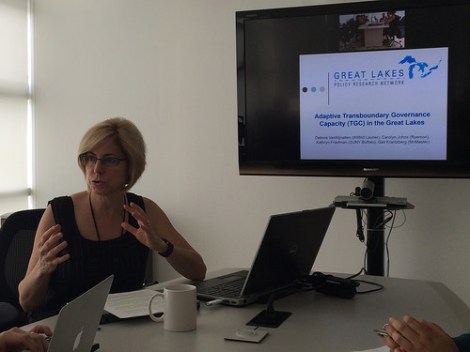
Last month, the Centro de Investigación y Docencia Económicas, where I work, hosted Dr. Debora VanNijnatten, an Associate Professor and Chair of the Political Science and North American Studies department at Wilfrid Laurier University. She specializes in issues of bilateral governance across North America, and is working with a research group examining how institutions coordinate across borders to tackle environmental challenges, including climate change. Although she has also studied the U.S.-Mexico border, currently her work is focused on the Great Lakes region to understand how the United States and Canada handle shipping, resource management, and other activities. It is a region with a long history of treaties and binational agreements, which has forged a highly institutionalized space to address concerns of land and water use.

26759069292_c92dc66128

Dr. Debora VanNijnatten. Photo credit: Dr. Raul Pacheco-Vega.

During the seminar, Dr. VanNijnatten noted that although there are a number of binational institutions in place, significant environmental problems that are difficult to resolve continue to face the region. Organizations have successfully addressed targeted problems, but larger, and more complex issues, such as dealing with cross-sector challenges that affect numerous communities and public/private interests, are a much harder task. Many scientists who study the Great Lakes area are concerned that this border region is at an ecological tipping point.

As a historian of the US-Mexico borderlands, what struck me most about Dr. VanNijnatten’s work is the importance of thinking about the history of institutions and transboundary governance. Certainly, issues of water and land use have deeply marked the U.S.-Mexico border region as well; from the impact of building of the Hoover Dam for the Colorado River Basin to modern-day disputes over water management in times of severe drought. A multidisciplinary approach that incorporates an understanding of policymaking and quantitative/qualitative methods, within an historical context, can be useful to chart the longue durée of local, state, and federal decision-making in everyday life along the border. The industrial and transport infrastructure built between nations affects economic access for regional communities (benefitting some places more than others) and also leaves a lasting mark on the natural environment. An historical understanding of the institutions that were formed to determine and enforce bilateral agreements is critical to developing a clearer view of how people cope with the challenges of managing borderlands resources.

Returning to Dr. VanNijnatten’s work, her group is developing a model to understand transboundary governance. They’re looking at a wide range of topics that affect communities and institutions, including degrees of compliance, info-sharing, and legal and political legitimacy. She notes that an important aspect of transboundary governance is how networks (people and communities) interact with institutions (government agencies, etc.) to understand and respond to regional problems. Her team finds that even in borderland areas, like the Great Lakes, with a long history of bilateral agreements, there still occurs considerable amounts of fragmentation and lack of coordination between nation-states. Thinking about how these themes address the history of the U.S.-Mexico border can inform our own work on the institutionalization of political and economic priorities in this region.

For more of Dr. VanNijnatten’s work, click here. My colleague, Dr. Raul Pacheco-Vega, has also written about this seminar, here.

Categories: conferences | Leave a comment

Summer Book Sale at OU Press

Dear readers, like any academic, we love a good book sale, too. The University of Oklahoma Press has just announced its summer sale with a large selection of titles available for up to 40%. For more details, follow the link.

2016-Summer-Sale--700px-wide

Categories: Book Sale, News and Announcements | Leave a comment

Q&A with Michel Hogue about “Metis and the Medicine Line: Creating a Border and Dividing a People”

On October 5, 2015, the Charles Redd Center for Western Studies at Brigham Young University hosted Michel Hogue (Associate Professor of History at Carleton University in Ottawa) to speak about his new book, Metis and the Medicine Line: Creating a Border and Dividing a People. You can watch the video of that talk below. His book was published in 2015 by the University of North Carolina Press with the aid of a Redd Center grant. Ever one to remind our community of scholars that there are borderlands to the north as well, I highly recommend his work and thankfully I am not the only one singing Hogue’s praises. Since its publication and his talk for the Redd Center, Metis and the Medicine Line has won the Stubbendieck Great Plains Distinguished Book Prize, was a finalist for the Canada Prize in the Humanities, and is still a finalist for the prestigious Sir John A. Macdonald Prize (winners to be announced on May 31).  Prof. Hogue was kind enough to participate in a Q&A below about the book. Questions by Brenden W. Rensink, responses by Michel Hogue.


Continue reading

Categories: Interviews | Tags: , , , | 3 Comments

Website Built with WordPress.com.