Race and Sex in Spain’s Colonial Borderlands

Dear readers, for those of you who will be in the area, the University of Texas at El Paso is hosting Dr. Allyson Poska for a public talk. She will be speaking at UTEP’s Blumberg Auditorium on April 21st, at 5PM, on the subject of personal honor in the colonial borderlands. Dr. Poska received her doctorate from the University of Minnesota, and since 1992, has taught in the Department of History and American Studies at the University of Mary Washington in Fredericksburg, Virginia. She is also the director of UMW’s Women’s and Gender Studies program. From her faculty bio:

Primarily a social historian, she regularly teaches upper-level courses on the histories of Spain and Latin America and frequently offers seminars dealing with gender issues. Her most recent book is Women and Authority in Early Modern Spain: The Peasants of Galicia (2006) which won the Roland H. Bainton Prize given by the Sixteenth Century Studies Association (the early modern history professional society) to the best book in early modern history or theology.

Allyson Poska Flyer-page-001

Categories: Events, News and Announcements | Leave a comment

The Economic Hierarchies of Globalization and Borders

Quartz, a news website, has a published an article on what it identifies as the major flaw in globalization: that the crossing of borders is framed in economic and logistical terms, not humanitarian ones. The issue at the heart of the story is the European Commission’s proposal to consider new visa requirements for US and Canadian visitors to the EU. The idea stems, in large part, from Washington’s refusal to grant visa free travel to many of the EU’s poorer members, including Romania. It also highlights what Quartz rightly identifies as the hypocrisy in how the West allows rich people virtually free movement across borders, whereas the poor are branded as economic migrants who face high barriers to entry. From the article:

One of the most iconic images of our open-world ideology is the fall of the Berlin Wall. But what could have been an opportunity to cement freedom of movement, association, and opportunity as global human rights instead became a symbol of the triumph of capitalism over communism. To this day, the notion of a world without walls is often framed in terms of trade and profit flows. This way of thinking has resulted, however inadvertently, in creating two different kinds of globalization: one for the rich, and another for the poor.

For more, visit Quartz.

Categories: News and Announcements | Leave a comment

“Democracy in the Fields” Website Release

Last Sunday (April 3, 2016) I had the pleasure of attending the launch of a wonderful new multi-media website that tells the story of “the summer of 1975,” which details the efforts of Salinas Valley farmworkers to join the United Farmworkers Union following the passage of California’s Agricultural Labor Relations Act in May of 1975 (signed into law on June 5, 1975 by Gov. Jerry Brown).

Democracy in the Fields was made possible by the collaboration of Miriam Pawel (author of The Crusades of Cesar Chavez), Mimi Plumb (photographer), Wendy Vissar (web designer), Bob Barber (journalist), and a generous grant from California Humanities. The event was held at the National Steinbeck Center.

demointhefields Continue reading

Categories: Interviews | Leave a comment

Q&A with Sujey Vega about LDS Latinos and Ethnic Religious Belonging in Arizona

On March 10, 2016, the Charles Redd Center for Western Studies at Brigham Young University was fortunate to host Sujey Vega, an Assistant Professor of Women and Gender Studies, Arizona State University. Prof. Vega works at the intersections of gender, ethnicity, and religious communities. Her current work explores the experiences of Latino members of the Church of Jesus Christ of Latter-day Saints (LDS or Mormon) in the politically charged atmosphere of the Arizona borderlands. Her lecture for the BYU Redd Center, entitled The Desert Diaspora: An Exploration of Latino Latter Day Saints and Their Ethnic Religious Belonging, can be viewed below in its entirety. To help offer more context for her work, she was kind enough to participate in a short Q&A, posted below, her current projects in Arizona and recent monograph, Latino Heartland: of Borders and Belonging in the Midwest (NYU Press, 2015).  Questions by Brenden W. Rensink and responses by Sujey Vega.


Continue reading

Categories: Interviews | Tags: , , , | 2 Comments

Symposium on the U.S. War with Mexico

On April 9th, 2016, the University of Texas at El Paso is hosting a symposium on the U.S. War with Mexico at the El Paso Historical Society. Dr. Sam Haynes from UT Arlington will be giving the keynote followed by a discussion on the history of this conflict. In addition, there will a lesson plan competition to select first, second, and third place winners with prizes. If you’re going to be in the area, definitely check it out! To RSVP, contact Brad Cartwright. For more information about competition submissions, visit CHTL.CHTL - hTX flyer (1)-page-001

Categories: conferences, News and Announcements | Leave a comment

CFP: Immigration, Integration, and Invasion

Dear readers, the University of London has a call for papers for its HistoryLab Annual Postgraduate Conference. This year’s theme is “950th Anniversary of 1066: A Millenium(ish) of Immigration, Integration, and Invasion.” Although it looks to the Norman invasion of the British isles as a starting point, the conference encourages a broad range of contributions that touch generally on the themes of migration and culture in an historical context, which may be a useful forum for scholars of borderlands. The organizers invite proposals for three-person panels, they welcome interdisciplinary perspectives, studying all geographic areas. A list of suggested topics includes:

  • Geographies and patterns of migration
  • Colonial emigration
  • Immigration for the purposes of labor
  • Forced emigration
  • Nation building, national identities, and nationalism
  • Experiences of immigrant communities
  • Globalization and international trade patterns
  • Gender, race, and religion
  • Diasporic communications and networks of influence

For more information, email: ihrhistorylab@gmail.com with “HistoryLab Conference” in the subject line. You can also follow the lab on Twitter: @IHRHistoryLab

The deadline to apply is April 1, 2016. Good luck!

Categories: Uncategorized | Leave a comment

A conversation with Natale Zappia, author of “Traders and Raiders: The Indigenous World of the Colorado Basin, 1540-1859.”

In Traders and Raiders: The Indigenous World of the Colorado Basin, 1540-1859 (UNC Press, 2014) Assistant Professor of History at Whittier College Natale Zappia provides an in-depth look into the “interior world” of the Lower Colorado River. Tracking the people, networks, economies, and social relations of an expansive indigenous world that includes parts of the modern-day states of Colorado, New Mexico, Utah, Arizona, California, Baja California, and Sonora, Mexico, Dr. Zappia narrates the history of the region through an examination of its diverse ecology and multiethnic political economy. Breaking from the Eurocentric narrative tropes of “discovery,” “conquest,” and “frontier,” Zappia’s interior world is a fluid borderland where the practices of trading and raiding are central in linking indigenous, Spanish, Mexican, and American people, ideas, and commodities into fragile interdependent networks emanating from indigenous trade centers and roadways along the Colorado and Gila Rivers. Traversing the pre-Columbian, Spanish, Mexican, and American eras, Traders and Raiders challenges us to consider anew the ecology, people, and developments that have shaped the region to the present-day.

Listen to this conversation in its entirety on the New Books in Latino Studies podcast.

Categories: Interviews | Leave a comment

The Centennial of Pancho Villa’s Raid on Columbus, NM: Intersections of History, Historical Memory, and Forgetting

We´re excited to welcome our newest contributor, Brandon Morgan, to the blog. Today, he writes a great piece on the historical memory and ceremony.  This post originally appeared in the blog, The Mexican Revolution: Memory, Culture, and History. -ed

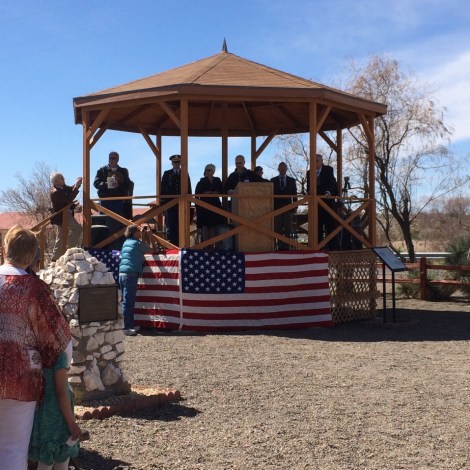
Slowly and surely...Speakers and dignitaries present as the Vill Raid memorial got underway in Columbus on March 9, 1916

Speakers and dignitaries assembled as the Villa Raid memorial got underway in Columbus on March 9, 1916.

Slowly and surely people arrived at the crossroads of New Mexico 9 and 11 where the old El Paso and Southwestern rail station stands. Today, the old depot houses artifacts and memorabilia from the turn of the twentieth century. Most specifically, it contains relics that gained significance on the early morning of March 9, 1916, when General Francisco “Pancho” Villa led about 480 men across the international boundary three miles
southwest of town.

One hundred years later, behind the historic train station, restored over the past few decades through the efforts of the Columbus Historical Society (CHS), a slight, cool breeze flapped the edges of the American flags draped across the replica of General Pershing’s review stand and the desert sun grew warmer. I arrived just as the CHS memorial ceremony to mark the centennial of Villa’s raid got underway. Like most of the other 150 or so attendees, I had traveled hundreds of miles to participate in the ceremony to honor the memory of the eighteen Americans who were killed during the course of the attack. Only a handful of the participants in the memorial hailed from Columbus. Continue reading

Categories: Events | 7 Comments

BHIP#7: We Speak to Pablo Mitchell!

Box_mitchell_pablo_web

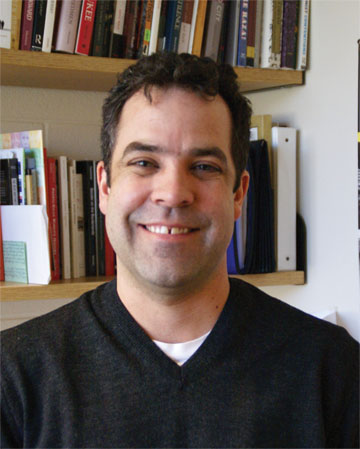
Where did the months go this year? The BHIP took a bit of a break since our last interview in December, but we are back and ready to meet another wonderful Borderlands scholar. It is my pleasure to introduce Pablo Mitchell to our BHIP audience. Dr. Mitchell is currently Associate Dean of the College of Arts and Sciences and is Professor of History and Comparative American studies at Oberlin College. He received his M.A. in 1995 at the University of New Mexico and his PhD in 2000 from the University of Michigan. He is the author of several books, including the award winning, and one of my personal favorites, Coyote Nation: Sexuality, Race, and Conquest in Modernizing New Mexico, 1880-1920 (University of Chicago Press, 2005) as well as West of Sex: Making Mexican America, 1900-1930 (University of Chicago Press, 2012) and his latest, a textbook titled History of Latinos: Exploring Diverse Roots (Greenwood Press, 2014). We talked about his research, his ideas about sexuality, race, gender, and the body, as well as emerging questions in Borderlands history, and teaching history.

Mitchell pointed to one of the underlying tensions he feels has driven his work in Borderlands history. He explains that while some historians continue with a Boltonian sense of the borderlands, his allegiance lies more with Cherrie Moraga and Gloria Anzaldúa’s theories that have provided the theoretical framework for his research. Anzaldúa’s work helped Mitchell to think about sexuality, race, gender, and borderlands and to ask different questions of archival materials and read against the grain. Continue reading

Categories: Interviews | 3 Comments

CFP: Upcoming Mexico City Conference on Mobility

The T2M conference is a great opportunity to engage issues of mobility comparatively and also across borders. It will be meeting in Mexico City at the Quinta Colorada in Chapultepec Park between October 27-30th. The deadline to submit a proposal is March 18th.

This year’s theme is “Mobilities: Spaces of Flows and Frictions” which emphasizes “ideas such as territorialisation and de-territorialisation, movement-space, space-time, and claims that state space is an effect of motion. Mobility studies and mobility history help us to think about space as dynamic, relational, [and] open… it has physical geographies, historical rhythms, and occupies concrete socio-technological constellations that include durable infrastructures, vehicles, corridors, gates, or barriers.”

As a scholar of Borderlands history with an interest in mobility and migration issues, I have found this conference to provide fruitful discussion on these themes from historical and multidisciplinary angles (full disclosure: I am also on the organizing committee).

homepageImage_en_US.png

For more information, follow the link to the conference website:

14th T2M Annual Conference 2016 – Mobilities: Space of Flows and Friction


Categories: Calls for Papers | Leave a comment

Website Built with WordPress.com.